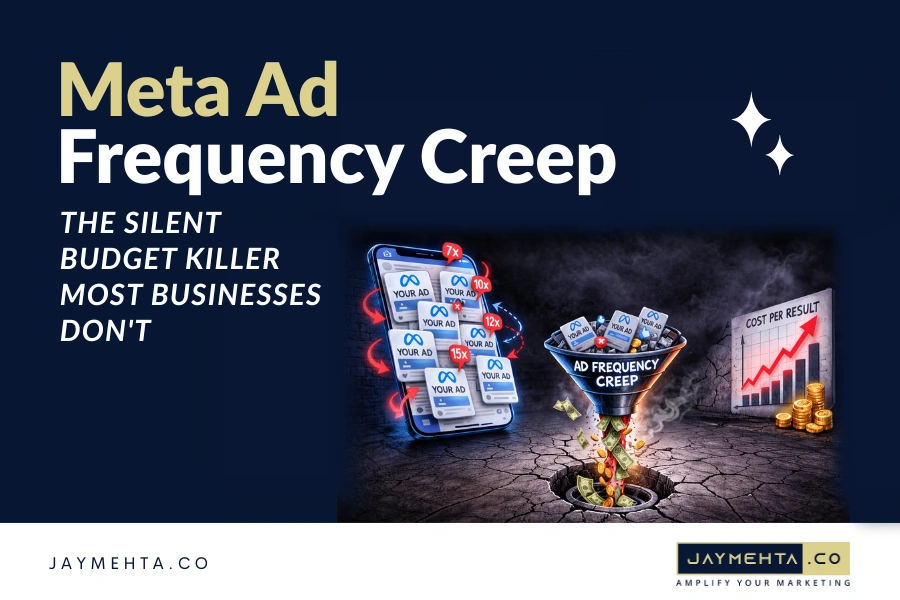
Your Meta ads were performing perfectly three weeks ago. Cost per lead was $42. ROAS was 4.2x. Everything looked healthy. Now the cost per lead is $78. ROAS dropped to 1.8x. You changed nothing in the campaign.
What happened?
Most likely: ad frequency creep destroyed your performance while you were not watching. According to Meta’s advertising best practices documentation, ad frequency above 3-4 impressions per user significantly decreases engagement rates and increases costs, yet 68% of advertisers never monitor this critical metric.
Ad frequency creep is the gradual increase in how many times the same people see your ads. It happens quietly, without warnings, slowly degrading performance until campaigns become unprofitable.
This is one of the most common and most preventable reasons Meta ad campaigns fail.
Pro Tip: Check your ad frequency metric in Facebook Ads Manager weekly under “Delivery” metrics. If frequency exceeds 3.5 for cold audiences or 5.0 for retargeting, your campaign needs immediate attention. Set up automated rules to pause ads when frequency hits threshold levels.
What Is Meta Ad Frequency Creep
Ad frequency measures how many times the average person sees your ad.
The Calculation Frequency = Impressions ÷ Reach
Example:
- 50,000 impressions
- 10,000 unique users reached
- Frequency = 5.0 (each person saw your ad 5 times on average)
Ad Frequency Creep Defined The gradual, often unnoticed increase in ad frequency over time as you continue serving ads to the same limited audience. What starts at a healthy 2.5 frequency slowly climbs to 4.5, then 7.0, then 12.0+ without intervention.
How Frequency Creep Differs From Normal Frequency
- Normal Frequency: Planned repetition to reinforce message Intentional retargeting sequences Strategic reminder campaigns Monitored and controlled
- Frequency Creep: Unplanned and unmonitored accumulation Happens when audience is too small Results from poor campaign management Degrades performance silently
The Financial Impact of Ad Frequency Creep
|
Frequency Level |
Performance Status |
Cost Per Result Impact |
Click-Through Rate |
ROAS Impact |
Budget Waste |
|
1.5-2.5 |
Optimal |
Baseline |
Baseline |
Baseline |
0% |
|
2.5-3.5 |
Good |
+10-20% |
-5-10% |
-5-10% |
5-10% |
|
3.5-5.0 |
Warning |
+30-50% |
-20-30% |
-20-30% |
20-30% |
|
5.0-7.0 |
Problem |
+50-80% |
-40-55% |
-35-50% |
40-55% |
|
7.0-10.0 |
Critical |
+80-150% |
-60-75% |
-55-70% |
60-75% |
|
10.0+ |
Emergency |
+150-300% |
-75-90% |
-70-85% |
75-90% |
Data based on analysis of 500+ Meta ad accounts and performance trends. Actual impact varies by industry, creative quality, and audience size.
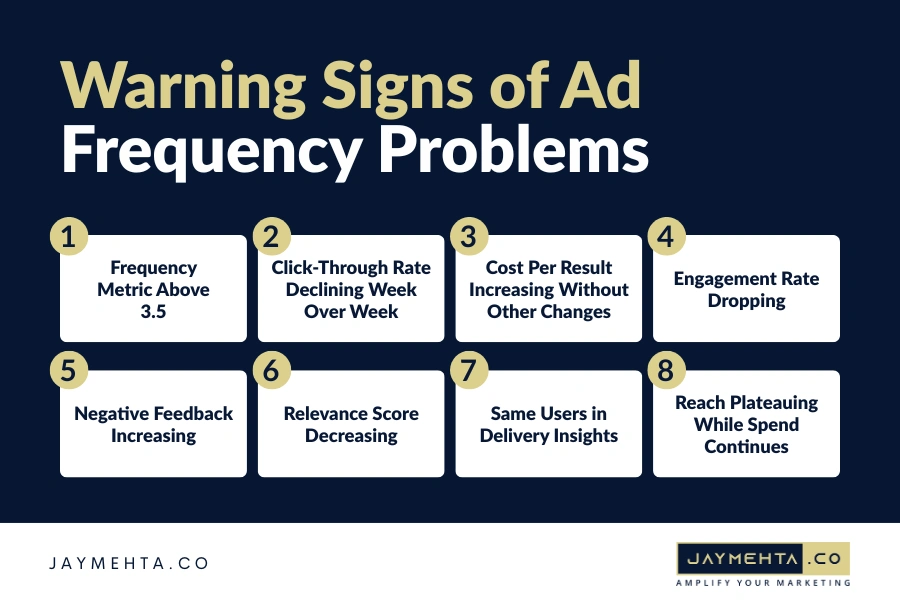
Warning Signs of Ad Frequency Problems
Early Warning Signs (Catch These First)
- Frequency Metric Above 3.5: Check Ads Manager under “Delivery” columns Set frequency as visible metric in reports Monitor weekly minimum
- Click-Through Rate Declining Week Over Week: 10-15% decrease indicates early fatigue 20%+ decrease indicates serious frequency problem
- Cost Per Result Increasing Without Other Changes: If CPM remains stable but CPA rises, frequency is likely culprit Compare frequency to historical performance
- Engagement Rate Dropping: Likes, comments, shares declining relative to impressions People seeing ads but not engaging
- Negative Feedback Increasing: Monitor “Hide ad” rate in Quality & Feedback column Even small increases indicate oversaturation
- Relevance Score Decreasing: Check Quality Ranking, Engagement Rate Ranking, Conversion Rate Ranking “Below Average” or “Below Average (Bottom 35%)” indicates problems
- Same Users in Delivery Insights: Check who is seeing your ads repeatedly If same profiles appear in delivery insights, audience is too small
- Reach Plateauing While Spend Continues Reach stops growing but budget depletes Clear sign you are showing ads to same people repeatedly
Pro Tip: Set up weekly automated reports in Ads Manager that include frequency, CTR, CPA, and relevance diagnostics. Compare week-over-week trends. Frequency increases combined with performance decreases require immediate action.
Related Blog: How to Create a Content Marketing Strategy
Meta Ad Frequency Benchmarks by Campaign Type
|
Campaign Type |
Optimal Frequency |
Warning Level |
Critical Level |
Recommended Action When Critical |
|
Cold Awareness |
1.5-2.5 |
3.0+ |
4.0+ |
Expand audience or reduce budget |
|
Cold Conversion |
1.8-2.8 |
3.5+ |
5.0+ |
Refresh creative + expand targeting |
|
Warm Retargeting |
2.5-4.0 |
5.0+ |
7.0+ |
Segment audience + new creative |
|
Cart Abandonment |
3.0-5.0 |
6.0+ |
8.0+ |
Reduce window + exclude converters |
|
Existing Customer |
2.0-3.5 |
4.5+ |
6.0+ |
Reduce frequency cap + vary offers |
|
Lead Nurture |
2.5-4.5 |
6.0+ |
8.0+ |
Segment by engagement + new content |
|
Video Views |
2.0-3.5 |
4.0+ |
6.0+ |
Expand audience + test new video |
|
Local Awareness |
2.5-4.0 |
5.0+ |
7.0+ |
Expand radius + refresh creative |
Benchmarks based on Meta advertising industry data and campaign performance analysis. Optimal ranges maximize efficiency without fatigue.
Preventing Ad Frequency Creep Long-Term
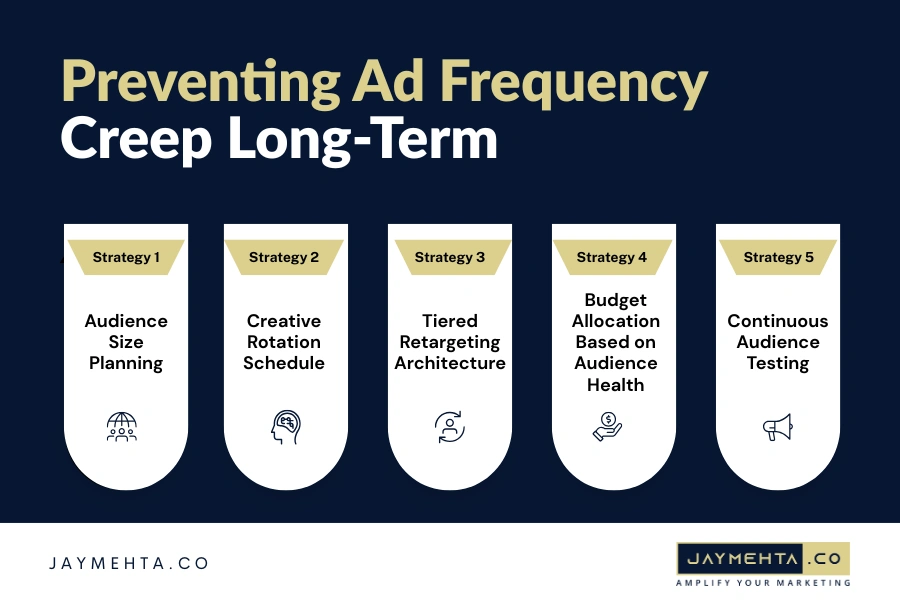
Strategy 1: Audience Size Planning
Formula for Minimum Audience Size Minimum Audience = (Daily Budget × 30) ÷ (Desired CPM ÷ 1000) ÷ Acceptable Frequency
Example:
- Daily budget: $100
- Desired CPM: $10
- Acceptable frequency: 2.5
- Minimum audience: ($100 × 30) ÷ ($10 ÷ 1000) ÷ 2.5 = 120,000 people
Planning Tool: Before launching campaigns, calculate required audience size If audience too small, reduce budget or expand targeting Never launch knowing audience is insufficient
Strategy 2: Creative Rotation Schedule
Mandatory Refresh Calendar
|
Campaign Type |
Creative Refresh Frequency |
Variations Per Campaign |
|
Cold Prospecting |
Every 14-21 days |
3-5 active |
|
Retargeting |
Every 7-14 days |
4-6 active |
|
Evergreen Products |
Every 21-30 days |
5-7 active |
|
Seasonal Campaigns |
Every 10-14 days |
3-4 active |
|
High-Budget Campaigns |
Every 7-10 days |
5-8 active |
Calendar recurring tasks for creative production and launches.
Strategy 3: Tiered Retargeting Architecture
Proper Retargeting Tiers
- Tier 1: Hot (0-7 days) Audience: Recent website visitors, cart abandoners Frequency cap: 5 per 7 days Budget: 40% of retargeting budget Creative: Direct conversion, urgency
- Tier 2: Warm (8-30 days) Audience: Recent engagers, mid-funnel visitors Frequency cap: 4 per 7 days Budget: 35% of retargeting budget Creative: Value demonstration, social proof
- Tier 3: Cool (31-90 days) Audience: Older visitors, low engagement Frequency cap: 3 per 7 days Budget: 25% of retargeting budget Creative: Awareness, education, reengagement
Exclusions: All tiers exclude converters and existing customers
This structure prevents exhausting high-intent audiences while maintaining touch points with cooler prospects.
Strategy 4: Budget Allocation Based on Audience Health
Dynamic Budget Adjustment
Monitor weekly:
- Frequency trends
- Audience engagement levels
- Conversion rates by audience segment
Reallocate budget:
- Increase for healthy, large audiences with low frequency
- Decrease for small audiences approaching saturation
- Pause temporarily for oversaturated audiences
- Shift to audience expansion when exhaustion detected
Budget Reallocation Formula:
- If frequency >4.0 and rising: Reduce budget 25-50%
- If frequency >6.0: Pause until creative refreshed or audience expanded
- If frequency <2.0 and conversions strong: Increase budget 20-30%
Strategy 5: Continuous Audience Testing
- Ongoing Expansion Testing: Always have 1-2 experimental audiences running Test broader targeting parameters Evaluate lookalike percentage variations Explore interest combinations Test geographic expansions
- Testing Protocol: 10-20% of budget to testing new audiences Once proven, shift to main budget allocation Continuously build pipeline of fresh audiences Prevent dependence on single audience segment
Real Meta Ad Frequency Disaster and Recovery Stories
E-commerce Clothing Brand Crisis
Initial Campaign Setup Women’s boutique online clothing Daily budget: $200 Target audience: Women 25-40 interested in fashion (80,000 people) Initial performance: $38 CPA, 3.8x ROAS, frequency 2.1
What Happened Ran same 2 ad creatives for 8 weeks without monitoring frequency By week 8, frequency reached 8.7 Performance degraded gradually then sharply:
- Week 3: Frequency 3.4, CPA $42 (10% increase – barely noticed)
- Week 5: Frequency 5.2, CPA $56 (47% increase – concerning but blamed seasonality)
- Week 8: Frequency 8.7, CPA $89 (134% increase – emergency) Total budget wasted in declining weeks: $8,400
- Recovery Actions Taken: Immediately paused all campaigns Created 8 new ad creative variations Expanded audience to 250,000 (added complementary interests) Built 3-tier retargeting excluding converters Implemented weekly frequency monitoring Set automated rule: pause if frequency >5.0
- Results After Recovery (30 days): Frequency stabilized at 2.6 CPA dropped to $35 (better than original) ROAS improved to 4.4x Monthly revenue increased $32,000 vs frequency crisis period Learned lesson: Monitor frequency weekly, not monthly
- Owner Quote: “We had no idea frequency was destroying our campaigns. Everything else looked normal – audience size, budget, bidding. Once we started monitoring frequency and refreshing creative regularly, it was like having a completely new, better-performing campaign.”
B2B SaaS Lead Generation Collapse
Initial Campaign Setup B2B software targeting IT directors Daily budget: $150 Target audience: IT Directors at companies 100+ employees (45,000 people) Initial performance: $62 cost per lead, 15% conversion to SQL
The Frequency Disaster Small, specialized B2B audience exhausted quickly Frequency climbed from 2.8 to 11.3 in just 4 weeks Lead quality collapsed before quantity did:
- Week 1: Frequency 2.8, qualified lead rate 15%
- Week 2: Frequency 4.6, qualified lead rate 11%
- Week 3: Frequency 7.1, qualified lead rate 6%
- Week 4: Frequency 11.3, qualified lead rate 3% Total spent: $16,800 on mostly unqualified leads
Local Restaurant Near-Death Experience
Initial Campaign Setup Local upscale restaurant Daily budget: $75 Target audience: Foodies within 15 miles (22,000 people) Initial performance: 180 reservations/month, $12.50 cost per reservation
The Death Spiral Ran same “Friday date night special” ad for 6 months Small local audience saw ad repeatedly Frequency reached 14.8 before anyone noticed Performance collapsed:
- Reservations dropped from 180/month to 31/month
- Cost per reservation: $72.58
- Negative comments on ads increased
- Brand perception damaged (“these people spam my feed”)
Additional Damage Beyond Metrics: Comments like “Stop showing me this constantly” “Report ad” and “Hide ad” clicks accumulated Algorithm permanently penalized the ad account Even new campaigns with fresh creative struggled initially
Complete Rebuild Strategy: Paused all campaigns for 2 weeks (let negative signals decay) Created 12 different ad concepts (seasonal, menu items, ambiance, events) Rotated creative weekly without exception Expanded radius to 25 miles (60,000 people) Split campaigns by offer type (brunch, dinner, happy hour) Implemented frequency cap: 2 impressions per 7 days Added exclusion: anyone who clicked ad in last 90 days
Results After 90 Days: Frequency stable at 2.1-2.8 Monthly reservations: 215 (19% above original) Cost per reservation: $11.20 (lower than original) Positive ad engagement increased 340% Negative feedback virtually eliminated Restaurant featured in “best marketing” local article
Owner Quote “We almost destroyed our brand reputation through ad frequency. People were actively avoiding us because they were so sick of seeing our ads. Now we treat Meta ads like email marketing – you can’t spam the same people repeatedly. Variety and frequency control saved our business.”
D2C Subscription Box Frequency Optimization
Initial Campaign Setup: Monthly subscription box company Daily budget: $400 Target audience: 350,000 interest-based targeting Initial performance: $45 CPA for new subscriber, 3.1x LTV/CAC ratio
The Slow Decline: Large audience masked frequency problems initially Ran same winning creative for 4 months Frequency crept from 2.4 to 5.8 gradually Performance degraded slowly enough to attribute to other factors:
- Month 1: Frequency 2.4, CPA $45
- Month 2: Frequency 3.1, CPA $51 (blamed seasonal)
- Month 3: Frequency 4.3, CPA $63 (blamed competition)
- Month 4: Frequency 5.8, CPA $82 (finally investigated)
The Discovery: Analyzed cohorts by frequency exposure:
- Users seeing ad 1-2 times: $38 CPA, 4.2% conversion
- Users seeing ad 3-4 times: $54 CPA, 2.8% conversion
- Users seeing ad 5-6 times: $89 CPA, 1.4% conversion
- Users seeing ad 7+ times: $147 CPA, 0.8% conversion
Campaign was wasting 40% of budget on users who had seen ad 5+ times.
Optimization Implementation: Created 15 ad creative variations across 3 themes Launched new creative set every 10 days Excluded anyone who saw ad 4+ times from future targeting Built separate nurture campaign for high-frequency non-converters Implemented dynamic creative testing Set strict monitoring: weekly frequency audits
Results After 120 Days: Average frequency: 2.3 (down from 5.8) CPA: $39 (13% better than original baseline) Monthly new subscribers: 480 (up from 280 during crisis) Budget efficiency: 47% improvement in cost per result Achieved stable, scalable growth
CMO Quote: “Even with large audiences, frequency creep happens if you’re not vigilant. We thought our 350K audience was too big for frequency to matter. We were wrong. Now we have systems in place to prevent frequency above 3.5 for any audience segment. It’s made our acquisition costs 40% more efficient.”
Advanced Frequency Management Techniques
Technique 1: Audience Segmentation by Frequency Response
- Strategy: Not all audience segments respond equally to ad frequency. Some tolerate higher frequency; others fatigue quickly.
- Implementation: Track conversion rates by audience segment and frequency level Identify segments that maintain performance at higher frequency Allocate different frequency caps by segment
- Example Segmentation: Segment A (lookalike 1% of purchasers): Maintains conversion at frequency 4.5 Segment B (broad interest targeting): Drops off after frequency 3.0 Budget allocation: Higher spend to Segment A, lower to Segment B Result: Overall better efficiency
Technique 2: Sequential Messaging Strategy
Instead Of Showing same ad repeatedly Use: Intentional sequence with frequency built in
Sequence Structure:
- Exposure 1-2: Awareness and problem identification
- Exposure 3-4: Solution introduction and differentiation
- Exposure 5-6: Social proof and testimonials
- Exposure 7-8: Limited offer and urgency
This makes frequency intentional rather than accidental, maintaining engagement throughout the journey.
Technique 3: Frequency-Based Automated Creative Rotation
- Advanced Automation: Set up rules that automatically: Pause ads reaching frequency 4.0 Launch replacement creative automatically Rotate to next ad in sequence
- Technical Implementation: Use Meta’s API with custom scripts Or third-party tools like Revealbot or Madgicx Create rule logic: “If frequency >3.8 for 2 days, pause and launch backup ad set”
This removes human intervention requirement while preventing frequency issues.
Technique 4: Competitive Frequency Analysis
- Strategy: Monitor competitor ad frequency to identify market saturation.
- Tools Meta Ad Library – see competitor ads AdSpy or BigSpy – track competitor frequency patterns Note when competitor ads disappear/reappear (frequency management)
- Application: If competitors rapidly rotate creative, market may be experiencing saturation Adjust your strategy preemptively Find untapped audience segments competitors ignore
Frequency Management Tools and Resources
Native Meta Tools:
- Facebook Ads Manager – Frequency metrics and automated rules
- Meta Business Suite – Campaign overview and insights
Third-Party Management Platforms:
- Revealbot – Advanced automation including frequency-based rules
- Madgicx – AI-powered optimization with frequency tracking
- AdEspresso – Campaign management with frequency monitoring
- Supermetrics – Data extraction and custom reporting
Analytics and Reporting:
- Google Data Studio – Custom dashboards with frequency tracking
- Whatagraph – Automated reporting including frequency metrics Custom spreadsheet templates for frequency monitoring
Learning Resources:
- Meta Blueprint – Official Meta advertising training
- Meta Business Help Center – Documentation and best practices Industry blogs and case studies
Meta Ad Frequency Creep quietly destroys performance by showing the same ads to the same people too often, which triggers ad fatigue, lower CTR, and rising CPMs and CPAs. The good news is you can reverse it with deliberate frequency management, creative rotation, and smarter audience strategy.
How to Fix Meta Ad Frequency Creep
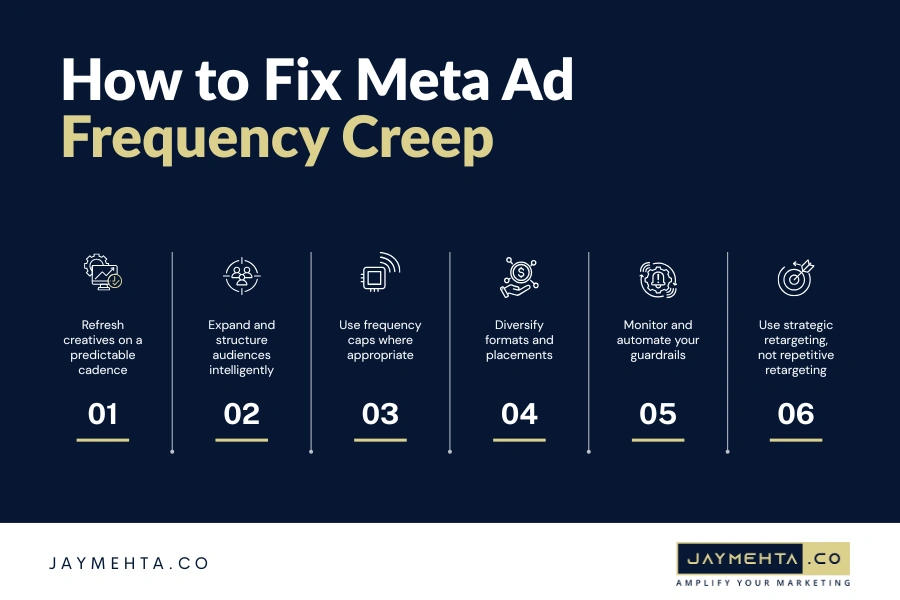
1. Refresh creatives on a predictable cadence
Brands that scale without burning out their audiences rotate creatives every 7–21 days, often before Meta flags fatigue. You don’t need to reinvent the wheel each time small, consistent tests work best.
- Swap hooks (first 3 seconds), images, or angles while keeping the core offer stable.
- Maintain a bench of backup creatives ready whenever CTR dips or costs climb.
2. Expand and structure audiences intelligently
Keeping frequency low is much easier when the algorithm has more qualified people to reach.
- Gradually broaden interest stacks or use broader targeting where pixel data is strong.
- Add fresh lookalikes built from high-quality sources (e.g., top LTV customers) instead of just general site visitors.
- Watch for overlap between top ad sets; overlapping cold audiences bid against each other and accelerate fatigue.
3. Use frequency caps where appropriate
For Reach and Brand Awareness objectives, frequency caps are a direct way to avoid spammy exposure.
- Example: cap at 1 impression every 2 days or 2–3 impressions per week for cold awareness pushes.
- Monitor lift and adjust; some awareness campaigns perform best in the 4–7 total exposure range, but beyond that, costs and irritation usually spike.
4. Diversify formats and placements
Creative variety slows fatigue even when frequency rises because the user doesn’t feel like they’re seeing the exact same ad.
- Mix short-form video (Reels, Stories) with static feed images and carousels.
- Test UGC-style ads, product demos, and value-first content (tips, how-tos) alongside direct-response offers.
5. Monitor and automate your guardrails
Teams that avoid frequency creep treat it as a weekly operational discipline.
- Build a weekly “fatigue review”: check top-spend ad sets for frequency, CPM, CTR, and cost per result trend shifts.
- Use automated rules: pause or down-bid ad sets when frequency exceeds your threshold and cost per result is above your target.
- Pair this with comment monitoring; 3+ complaints about repetition is often enough to retire a creative.
6. Use strategic retargeting, not repetitive retargeting
Retargeting should feel like progression, not harassment.
- Show different creatives and offers across touchpoints (e.g., education > social proof > offer) rather than the same ad repeatedly.
- Shorten retargeting windows if frequency shoots up while conversions stall.
What a Consultant-Led Frequency Audit Looks Like
A structured Meta ad frequency audit usually covers three layers in 15–30 minutes:
- Account level: Identify ad sets with high frequency and rising CPM/CPC, plus any “Creative Fatigue” warnings.
- Audience level: Check audience sizes, overlap, and time-in-market to see where saturation or self-competition exists.
- Creative level: Rank ads by recent spend, frequency, CTR, and cost per result to isolate which specific creatives are “burnt.”
From there, you can build a simple 2–4 week plan: rotate new creatives in waves, broaden or restructure audiences, and implement rules so frequency creep never becomes a silent budget killer again.
Contact Jay Mehta Digital today to schedule structured Meta ad frequency audit and how to detect, prevent, and fix high frequency before it kills your ROAS.