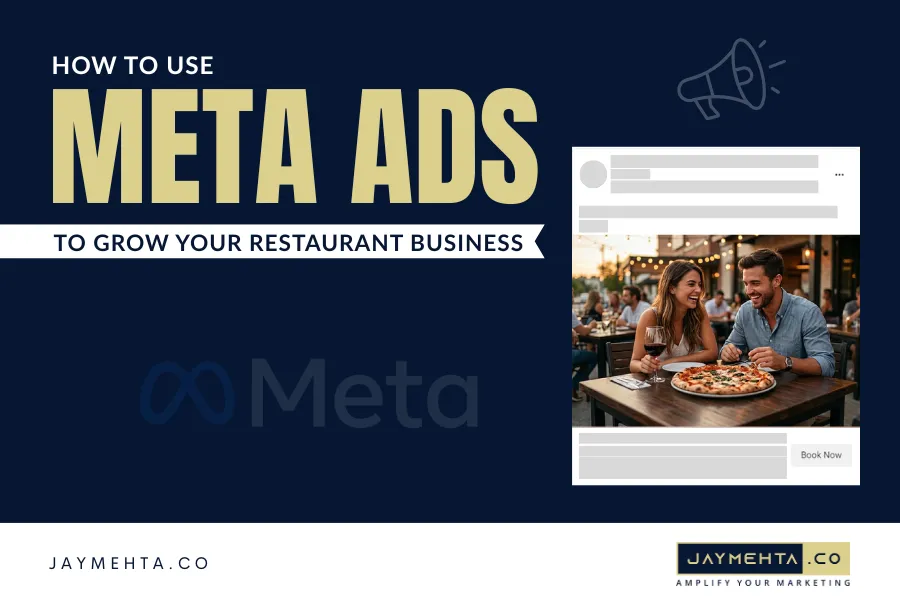
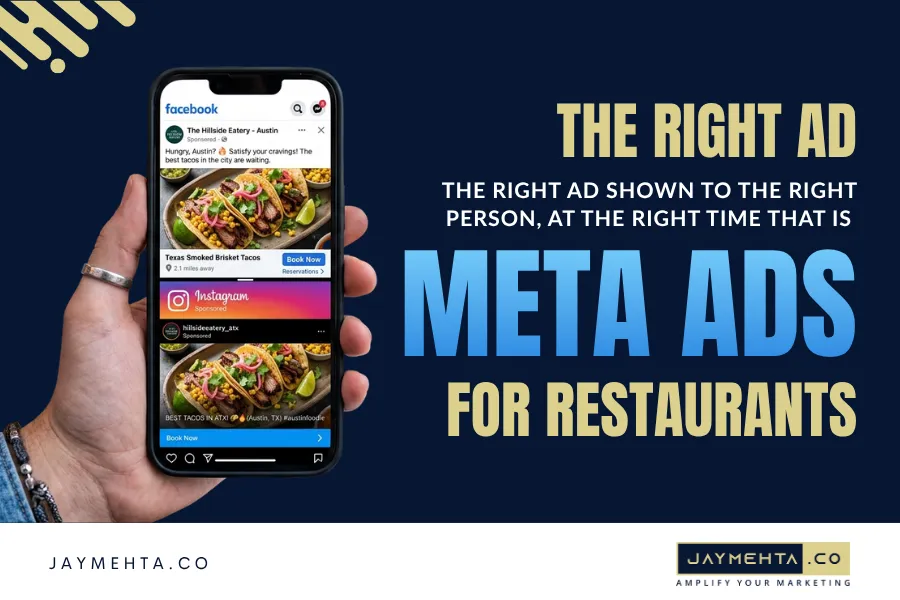
You have great food, a welcoming ambiance, and a passionate team. But if the right people in Austin are not seeing your restaurant, your tables stay empty. That is where Meta ads for restaurants come in.
Meta ads running across Facebook and Instagram give restaurant owners the ability to put their food, offers, and brand directly in front of thousands of hungry, local customers who have never heard of them before. Unlike organic social media, which depends on followers and algorithms, Meta ads let you choose exactly who sees your content, where they live, what they are interested in, and when they see it.
This guide walks you through everything you need to know about using Meta ads for restaurants from setting up your first campaign to advanced targeting, budgeting, and creative strategies that actually fill tables.
Check: How to Use Meta Ads for Maximum Conversions to Grow Your Business
Why Meta Ads Work So Well for Restaurants
Before diving into tactics, it is important to understand why Meta ads for restaurants are one of the most powerful paid marketing tools available today.
Restaurants are visual businesses. Food, ambiance, energy these are things people want to see before they decide where to eat tonight. Facebook and Instagram are inherently visual platforms built for exactly this kind of content.
Here is what makes Meta ads uniquely powerful for restaurants:
- You can target people within a 3 to 10 mile radius of your restaurant
- You can reach people based on their interests dining out, foodie culture, craft beer, brunch, live music
- You can retarget people who visited your website, watched your videos, or engaged with your page
- You can run offers and promotions that drive immediate action — reservations, online orders, and walk-ins
- You can reach brand new audiences who have never heard of you but match your ideal customer profile exactly
According to Hootsuite’s Digital Report, Facebook and Instagram together reach over 3.2 billion people monthly. Even with hyper-local targeting in a city like Austin, that gives you access to a massive local audience at a fraction of the cost of traditional advertising like print or radio.
Step 1: Set Up Your Meta Business Manager the Right Way
Before you run a single ad, you need to set up your foundation correctly. Skipping this step leads to wasted budget, tracking errors, and accounts that get flagged by Meta.
Create Your Meta Business Manager Account
Go to business.facebook.com and create a Business Manager account using your restaurant’s name. This is the central hub where you manage your Facebook Page, Instagram account, ad account, and pixel — all in one place.
Connect Your Facebook Page and Instagram Account
Inside Business Manager, connect your restaurant’s Facebook Page and Instagram account. All your ads will run from these pages, and both platforms will be managed from a single dashboard.
Set Up Your Meta Pixel
The Meta Pixel is a small piece of code you install on your website. It tracks visitor behavior — which pages they visit, whether they complete a reservation, how long they stay — and feeds that data back to Meta so you can retarget those visitors with ads later.
Installing the Pixel before you run any ads is critical. It builds your custom audience data from day one and makes your retargeting campaigns significantly more effective over time.
Add Your Payment Method
Add a credit or debit card to your ad account before launching any campaign. Meta requires a valid payment method and will pause your ads if billing fails.
Pro Tip: Always run ads from your Business Manager ad account, not from the “Boost Post” button on your Facebook Page. Boosting posts gives you very limited targeting options and significantly less control over your budget and results. Most Austin restaurant owners make this mistake and wonder why their ads do not perform.
Step 2: Understand the Meta Ads Structure for Restaurants
Before building your first campaign, understand how Meta organizes its ads. Every Meta ads for restaurants campaign follows a three-level structure.
Campaign Level
This is where you choose your objective and what you want your ads to achieve. For restaurants, the most useful objectives are:
- Awareness: Show your restaurant to as many local Austin residents as possible
- Traffic: Send people to your website, menu page, or online reservation system
- Engagement: Get more likes, comments, shares, and saves on your posts
- Leads: Collect names, phone numbers, and emails directly within Meta without sending people to a website
- Conversions: Drive specific actions on your website — reservation completions, online orders
Ad Set Level
This is where you define your audience, location, budget, schedule, and ad placements. Each campaign can contain multiple ad sets targeting different audiences or testing different parts of Austin South Congress, East Austin, Downtown, and The Domain all attract very different dining crowds.
Ad Level
This is where you create the actual creative — your image, video, headline, body copy, and call-to-action button. Each ad set can contain multiple ads for testing different visuals and messages.
Key Insight: Always start with one clear objective per campaign. Restaurant owners who try to achieve awareness, leads, and conversions from a single campaign end up with confused results and wasted budget.
Step 3: Define Your Target Audience for Restaurant Meta Ads
Targeting is where most Austin restaurant owners either win or waste their money. The most beautiful ad in the world means nothing if it is shown to the wrong people.
Location Targeting
Set your location to a radius around your restaurant. For most Austin restaurants, 3 to 7 miles is the right range. If you are located in a high-traffic area like South Congress or Rainey Street, you can keep it tighter. If you are in a neighborhood spot in Mueller or Bouldin Creek, expand slightly to pull from surrounding areas.
For delivery-focused campaigns, target your specific delivery zones rather than a circle — this prevents wasted impressions on areas you do not serve.
Demographic Targeting
Layer your location with relevant demographics:
- Age: 25 to 54 for most Austin restaurants. The city skews younger, so adjust based on your actual customer base
- Gender: Run broad first both male and female unless your data shows a clear skew
- Language: English as primary, with Spanish layered in for neighborhoods like East Austin where the demographics support it
Interest-Based Targeting
This is where Meta ads become incredibly powerful for Austin restaurants. Layer your audience with interests like:
- Dining out
- Foodie culture and food tourism
- Craft beer and cocktails
- Brunch and weekend dining
- Live music and entertainment
- BBQ and Southern food
- Farm-to-table dining
- Austin local events and festivals
Custom Audiences
Custom Audiences are built from your own data — people who already know your restaurant:
- Website visitors tracked by your Meta Pixel
- People who watched your Facebook or Instagram videos
- People who engaged with your Instagram or Facebook page
- Your customer email list uploaded to Meta
Lookalike Audiences
Once you have a Custom Audience of at least 100 people, Meta can build a Lookalike Audience, a new group of people who share similar characteristics to your existing customers. For Austin restaurants, a 1% Lookalike of your best customers is one of the most cost-effective ways to reach new diners who are likely to love your food.
Pro Tip: Always exclude your existing Custom Audiences from cold acquisition campaigns. There is no point paying to reach people who already know and regularly visit your restaurant when you are trying to attract new customers.
Step 4: Choose the Right Meta Ad Formats for Your Restaurant
Not all ad formats work equally well for restaurants. Here is what performs best and when to use each one.
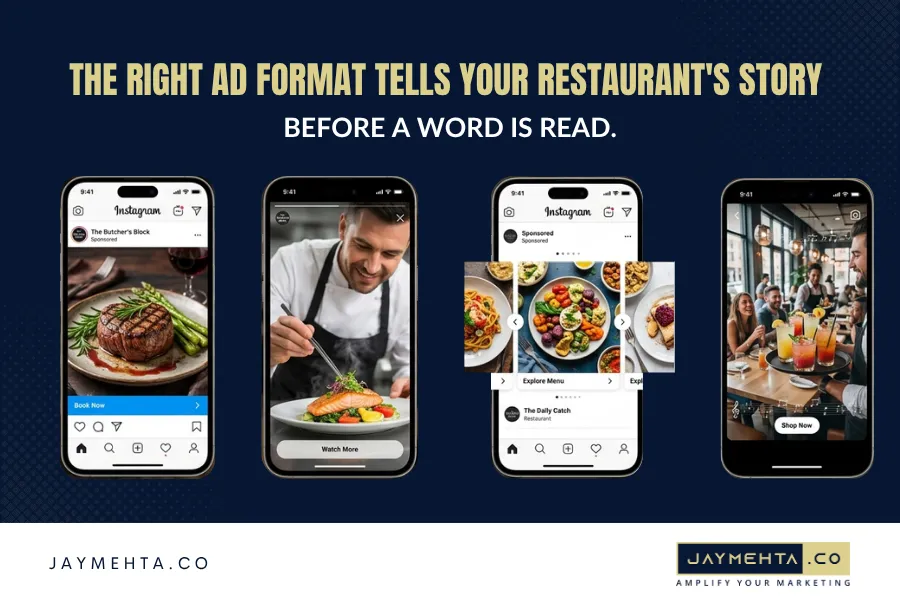
Single Image Ads
The simplest and most common format. One high-quality food photo with a compelling headline and a clear call-to-action. Best for promoting a specific dish, a limited-time offer, or a seasonal special. A stunning plate of smoked brisket or a perfectly crafted breakfast taco can stop an Austin foodie mid-scroll instantly.
Video Ads
Video consistently outperforms static images on both Facebook and Instagram. A 15 to 30 second video showing dish preparation, the restaurant ambiance, a chef at work, or a packed Saturday night dining room creates emotional connection and stops the scroll far more effectively than a photo.
Carousel Ads
Carousel ads let you show multiple images or videos in a single swipeable ad. Perfect for showcasing your full menu, highlighting multiple dishes, or telling a visual story about your restaurant’s experience from the first cocktail to the last bite of dessert.
Reel and Story Ads
Full-screen vertical ads that appear between Instagram Reels and Stories. These get high visibility and feel native to the platform. Best for short, punchy promotions — “This weekend only,” “New menu just launched,” “Reserve your table for Saturday night on 6th Street.”
Collection Ads
Collection ads open into a full-screen experience showing multiple dishes and offerings. Ideal for Austin restaurants with strong food photography across multiple menu categories — starters, mains, desserts, and craft cocktails.
Step 5: Write Ad Copy That Makes People Hungry and Take Action
Great creativity stops the scroll. A great copy closes the deal. Your Meta ads for restaurants need both to perform consistently.
Headlines That Work for Austin Restaurant Ads
Your headline is the first thing people read after seeing your image or video. Keep it short, specific, and appetite-driven:
- “Wood-fired tacos made fresh every morning in East Austin.”
- “Austin’s favorite Sunday brunch just got a new menu. Come taste it.”
- “Live music. Cold drinks. The best smoked ribs in South Congress.”
- “Date night sorted. Book your table at Austin’s most romantic rooftop.”
- “Free appetizer with every reservation this weekend only.”
Body Copy Best Practices
- Lead with your strongest selling point dish quality, uniqueness, neighborhood location, or a specific offer
- Keep it under 3 sentences for feed ads. Austin diners scroll fast.
- Use sensory language describe taste, texture, smoke, spice, freshness
- Always end with a clear call to action: “Book your table now,” “Order online today,” “Reserve your spot this weekend”
Call-to-Action Buttons
Always use a Meta CTA button on every ad. The best performing CTAs for restaurant ads are:
- Book Now (for reservations)
- Order Now (for delivery or takeaway)
- Learn More (for new menu launches or brand awareness)
- Get Offer (for discount or promotional campaigns)
Key Insight: Avoid generic copy like “Come visit us for great food in Austin.” Every restaurant says something like this. Speak to something specific: a dish, an occasion, an experience, or a limited-time reason to act right now.
Step 6: Set the Right Budget for Your Restaurant Meta Ads
One of the most common questions Austin restaurant owners ask is how much to spend on Meta ads. The answer depends on your goals, market size, and competition but here is a practical framework.
Starter Budget (Testing Phase)
Spend $150 to $300 per month when starting out. This is enough to test 2 to 3 audiences, run 2 to 3 ad creatives, and gather meaningful performance data. Do not scale until you know what is working.
Growth Budget (Scaling Phase)
Once you have identified a winning audience and creative combination, scale to $500 to $1,500 per month. At this level, you can run multiple campaigns simultaneously awareness, retargeting, and lead generation while maintaining consistent reach across Austin and its surrounding neighborhoods.
Budget Allocation by Campaign Type
- 50% on cold audience acquisition (reaching new Austin diners who do not know you yet)
- 30% on retargeting (converting people who engaged with your content or visited your website but did not book)
- 20% on loyalty and repeat visits (promoting special offers to existing customers)
Daily vs Lifetime Budget
Use a daily budget when you want consistent spending every day, ideal for always-on awareness campaigns targeting Austin locals. Use a lifetime budget when running a specific promotion with a fixed end date Meta will automatically optimize delivery across your campaign period.
Pro Tip: Never judge a Meta ad campaign in the first 3 to 5 days. Meta’s algorithm needs time to exit the learning phase, a period where it tests delivery across your audience to find the most responsive people. Pausing campaigns too early means you will never see accurate results.
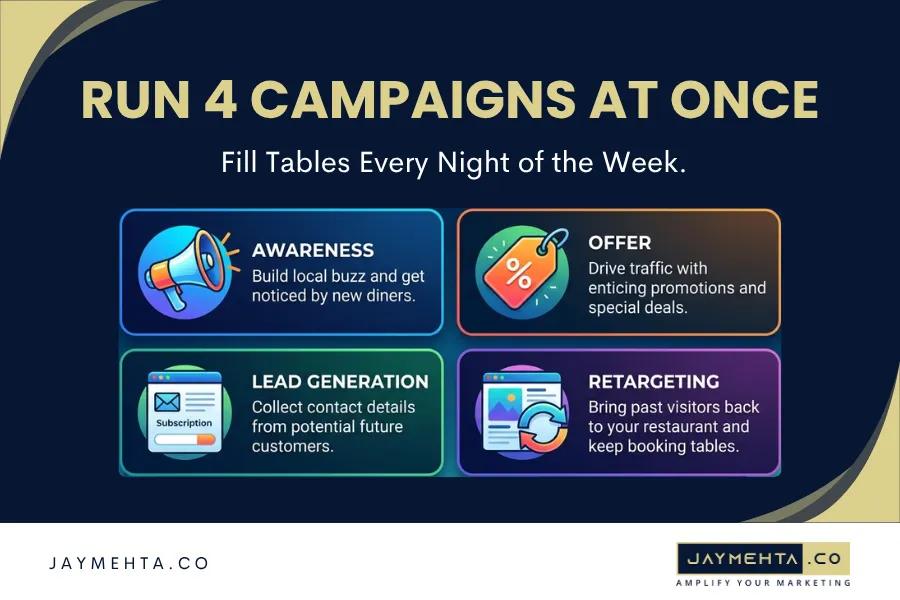
Step 7: Run the Four Most Effective Campaign Types for Restaurants
Different business goals require different campaign strategies. Here are the four most effective Meta ads for restaurants campaign types every Austin restaurant should run.
Awareness Campaigns
- Goal: Introduce your restaurant to Austin residents who have never heard of you.
- Audience: Cold local audience within 3 to 7 miles, layered with food and dining interests.
- Creative: Brand story video, ambiance reel, signature dish showcase, or a quick behind-the-scenes kitchen clip.
- CTA: Learn More or no button the goal here is reach and recall, not immediate conversion.
- Budget: $50 to $100 per month as a baseline brand-building investment.
Offer and Promotion Campaigns
- Goal: Drive immediate reservations, walk-ins, or online orders with a compelling incentive.
- Audience: Warm audience people who engaged with your page or visited your website plus a cold local audience.
- Creative: Clean food photo or short video with the offer front and center. Example: “Free dessert with every table booking this Saturday. Limited seats available.”
- CTA: Book Now or Get Offer.
- Budget: $100 to $300 per promotion depending on the size of the offer and expected revenue return.
Lead Generation Campaigns
- Goal: Collect names, phone numbers, and email addresses of Austin diners interested in your restaurant for your loyalty program, newsletter, or event RSVP list.
- Audience: Cold local audience, interest-layered.
- Creative: A clear value exchange “Join our VIP list and get 20% off your first visit” or “Sign up for our weekly specials and never miss a deal.”
- CTA: Sign Up or Get Offer the form fills within Meta so the user never has to leave the app.
- Budget: $100 to $200 per month to build your list consistently.
Retargeting Campaigns
- Goal: Convert warm prospects to people who already know your restaurant but have not yet visited or booked.
- Audience: Website visitors, video viewers (watched 50% or more of your video), page engagers, and Instagram profile visitors in the last 30 to 90 days.
- Creative: Social proof-driven content customer testimonials, review screenshots, packed dining room photos, behind-the-scenes clips. These people already know you. Now show them why others love you.
- CTA: Book Now or Order Now.
Budget: $75 to $150 per month. Retargeting audiences are small but highly qualified they convert at the highest rate of any campaign type.
Step 8: Track Performance and Optimize Your Restaurant Meta Ads
You cannot grow what you do not measure. Here are the key metrics every Austin restaurant owner needs to track when running Meta ads for restaurants.
Key Metrics to Track
- Cost Per Result: How much you are paying for each desired outcome — a click, a lead, a reservation, or a purchase. This is your primary efficiency metric.
- Click-Through Rate (CTR): The percentage of people who saw your ad and clicked on it. A strong CTR for restaurant ads is 1.5% to 3%. Below 1% usually means your creative or targeting needs adjustment.
- Reach and Frequency: How many unique people saw your ad and how many times on average. If frequency climbs above 4 to 5 without results, your audience is fatigued — refresh your creativity or expand your audience.
- Cost Per Click (CPC): The average cost for each click to your website or landing page. For local restaurant ads in Austin, a healthy CPC is $0.50 to $1.50 depending on your audience and objective.
- Return on Ad Spend (ROAS): For restaurants running conversion campaigns tied to online ordering, this tells you how much revenue you are generating for every dollar spent on ads.
- Lead Quality: For lead generation campaigns, track how many leads actually convert to reservations or visits. A high volume of low-quality leads means your offer or targeting needs refinement.
Tools to Use
- Meta Ads Manager — your primary dashboard for all campaign, ad set, and ad-level performance data
- Google Analytics 4 — track website traffic coming from Meta ads and monitor on-site behavior
- UTM Parameters — add UTM tags to all ad destination URLs so you can track Meta traffic accurately in Google Analytics
- Your reservation platform (OpenTable, Resy, or Toast) — cross-reference reservation spikes with your ad activity to measure real-world impact
Pro Tip: Set a weekly 20-minute review of your Meta Ads Manager. Check what is performing, pause what is not, and put more budget behind your winners. Consistent optimization is what separates restaurants that grow from those that waste their ad spend.
Common Meta Ads Mistakes Austin Restaurant Owners Make
Knowing how to run great Meta ads for restaurants also means knowing what kills campaigns before they have a chance to work.
Using the Boost Post Button Instead of Ads Manager
Boosting posts is the most expensive and least effective way to advertise on Meta. It limits your targeting, objectives, and optimization options. Always use Ads Manager.
Running Ads Without the Meta Pixel Installed
Without the Pixel, you cannot retarget website visitors, track conversions, or build Lookalike Audiences. This single omission cuts your campaign effectiveness in half.
Targeting Too Broadly
Targeting all of Texas or even all of Austin with no interest or demographic filters burns through budget with minimal return. Tight, layered local targeting always outperforms broad targeting for restaurants.
Using Low-Quality Food Photos
A poorly lit, unappetizing food photo in a Meta ad actively damages your brand. In a city like Austin where food photography standards are high, your creative must be excellent.
Never Testing New Creative
Running the same ad for months leads to audience fatigue and declining results. Refresh your creative at least every 4 to 6 weeks with new dishes, new offers, or new seasonal content.
Stopping Campaigns Too Early
Meta needs data to optimize. Stopping a campaign after 3 days because results look slow is one of the most common and costly mistakes restaurant owners make.
No Clear Call to Action
Every ad needs a purpose. “Visit us for great food” is not a call to action. “Book your table for Saturday night before it sells out” is.
Hidden Meta Ads Tips Most Austin Restaurants Never Use
These advanced tactics give you a serious edge over competitors who are only running basic campaigns.
Run Ads During Peak Decision-Making Hours
Most people decide where to eat between 11 AM to 1 PM for lunch and 4 PM to 7 PM for dinner. Use Meta’s ad scheduling feature to increase your bids and budget during these windows and pull back during off-hours.
Use Testimonial and Review Ads
Screenshot your best Google or Yelp reviews and turn them into ad creative. Social proof from real Austin customers converts at significantly higher rates than promotional product ads for cold audiences.
Promote Your Google Reviews With Meta Ads
Run a retargeting ad specifically asking past visitors to leave you a Google review. Example: “Loved your visit? Help other Austin foodies find us — leave us a Google review.” This bridges your paid social and organic search strategy simultaneously.
Create a VIP Loyalty Campaign
Run a lead generation campaign offering an exclusive VIP benefit — early access to new menus, a free appetizer on your birthday, or members-only happy hour pricing. Build your own first-party customer list independent of delivery platforms.
Test Austin Neighborhood-Specific Messaging
East Austin, South Congress, The Domain, and Downtown attract different crowds with different dining preferences. Create ad sets with neighborhood-specific copy and imagery for each area and see which responds best to your restaurant’s offering.
How Jay Mehta Helps Austin Restaurants Win With Meta Ads
Running profitable Meta ads for restaurants while managing a full restaurant operation is genuinely difficult. Campaign setup, creative production, audience testing, budget optimization, and performance analysis each one is a specialized skill that takes time to master.
That is where Jay Mehta comes in.
What Jay Mehta Offers
- Meta Ads Strategy: Custom campaign strategy built around your restaurant, your Austin neighborhood, your cuisine, and your target customer.
- Creative Direction: Ad copy, visual direction, and creative guidance for food photography and video content that stops the scroll and drives action.
- Full Campaign Management: Campaign setup, audience building, A/B testing, budget optimization, and daily monitoring across Facebook and Instagram.
- Pixel Setup and Tracking: Complete Meta Pixel installation, custom conversion tracking, and UTM parameter setup so every dollar of ad spend is accurately measured.
- Retargeting Systems: Custom audience building and retargeting campaign setup to convert warm leads into paying customers.
- Monthly Reporting: Clear, jargon-free performance reports showing exactly what your ads are doing reach, clicks, leads, reservations, and return on ad spend.
Ready to fill more tables in Austin with Meta ads? Book a meeting with Jay Mehta today and turn your Facebook and Instagram presence into a consistent, measurable revenue driver for your restaurant.