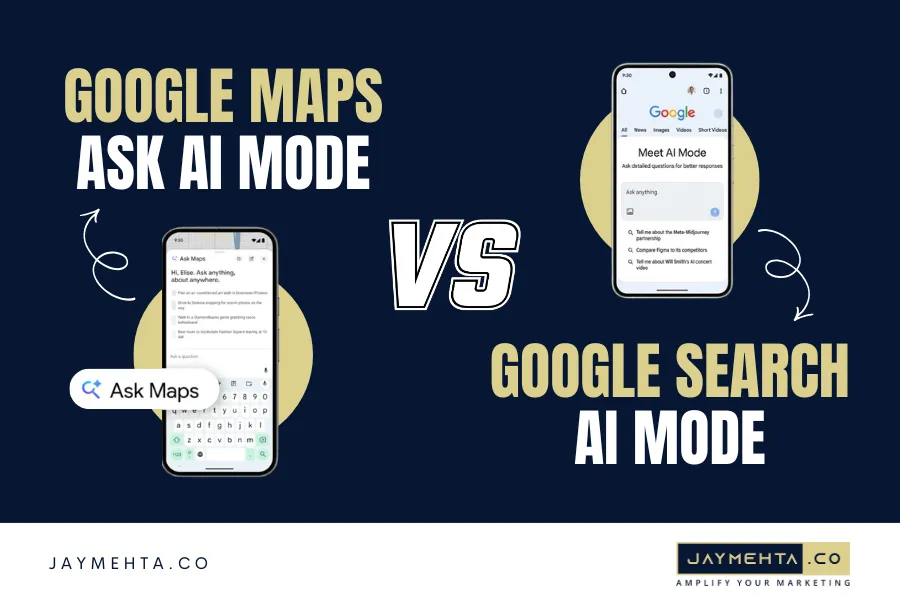
Two major AI features from Google launched within months of each other and most business owners are already confusing them.
Google Search AI Mode and Google Maps Ask AI Mode both use Gemini. Both answer conversational questions. Both are reshaping how users find information online. But they work on completely different logic, serve completely different user intents, and reward completely different optimisation Digital Marketing strategies to improve SEO.
Treating them as the same thing and optimising for both in exactly the same way is one of the most costly mistakes a local business can make in 2026.
This article breaks down Google Maps Ask AI Mode vs Google Search AI Mode across every dimension that matters: how each works, what signals each prioritises, who wins in each environment, and exactly what your business needs to do differently for each one.
Also Check: Mastering Voice Search SEO: Optimization Strategies for Voice Search
Regular Maps vs AI Mode Search
| Feature | Regular Google Maps | AI Mode (Ask Maps) |
|---|---|---|
| User Input | Keywords (e.g., “roofer near me”) | Normal questions (e.g., “Find a roofer who fixes leaks and is available on weekends”) |
| Search Results | A list of businesses (the “local pack” or map view) | Often a single, top recommendation with a summary |
| User Task | Compare multiple options to find the best fit | Get a direct answer to a specific need right away |
| Key Ranking Factors | How close you are, relevance, and general reputation | Specific details, special skills, and what reviews say |
This table shows the main difference: the AI doesn’t want to give users homework; it wants to give them a solution. Your job is to convince the AI that your business is that solution.
The AI is now digging deeper into your online presence than ever before. It isn’t just looking at your business name and category. It’s reading your reviews, looking at your service descriptions, and checking your photos for small details that match a user’s question.
Also Check: Google Business Profile Photo Order Is Changing. Here’s Why Your Best Images Aren’t Showing First
What Is Google Search AI Mode
Google Search AI Mode is a Gemini-powered upgrade to the traditional Google Search results page. When a user searches for something complex or informational, instead of returning ten blue links, Google generates a structured AI answer synthesised from dozens of sources across the web with citations listed below.
Think of it as an evolved version of AI Overviews, but more conversational, more detailed, and more capable of handling multi-step follow-up questions within the same search session.
What Search AI Mode is built to do: Answer broad informational questions by pulling the most credible, authoritative content from across the entire web.
Example queries it handles well:
- “What are the best digital marketing strategies for small businesses in 2026?”
- “How does compound interest work and when should I start investing?”
- “What are the side effects of switching from running to cycling training?”
The user is seeking information, education, or guidance. They are not necessarily ready to transact they are researching.
What Is Google Maps Ask AI Mode
Google Maps Ask AI Mode, also called Ask Maps, is a Gemini-powered conversational search layer built directly inside the Google Maps app. It is designed for one specific purpose: recommending a single real-world local business that best matches what the user asked for.
There is no list of options. There is no comparison shopping. The AI picks one business and presents it with a short supporting summary drawn from reviews, GBP data, and location signals.
What Maps Ask AI Mode is built to do: Match a user’s specific local need with the single most trustworthy, relevant business in their area.
Example queries it handles well:
- “Find me a quiet café with outdoor seating near Bandra open before 8am”
- “Best dentist near Andheri who is good with nervous patients and has Saturday slots”
- “Emergency plumber in Juhu available tonight”
The user is ready to act. They want a business, not an article. The intent is transactional and immediate.
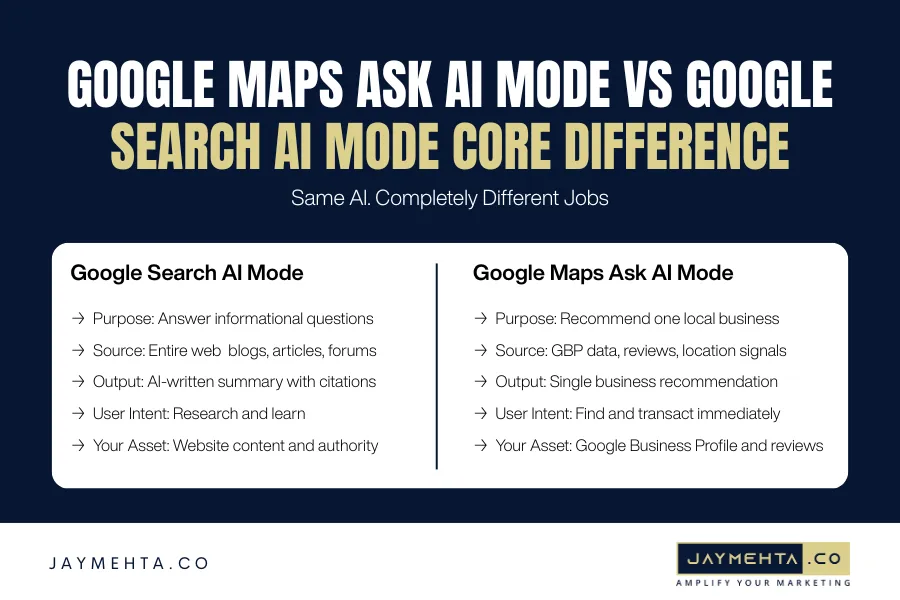
The 5 Biggest Differences Between the Two AI Modes
Understanding Google Maps Ask AI Mode vs Google Search AI Mode at a practical level means understanding exactly where they diverge and why those differences change your optimisation strategy completely.
-
User Intent Is Completely Different
- Search AI Mode serves informational intent the user wants to understand something. Maps Ask AI Mode serves transactional intent the user wants to hire, visit, or buy from someone right now.
- This is the most important difference of all. A user asking Search AI Mode “how do I fix a leaking tap” is a DIY researcher. A user asking Maps Ask AI Mode “plumber near me available tonight for a leaking tap” is a paying customer. Same topic. Opposite intent. Opposite optimization.
-
The Primary Data Source Is Different
- Search AI Mode pulls from across the entire public web blog posts, news articles, YouTube transcripts, Reddit threads, industry publications. Your website’s content quality, authority, and topical depth determine how much the AI references you.
- Maps Ask AI Mode pulls almost exclusively from your Google Business Profile your description, services, attributes, photos, Q&A, and customer reviews. Your website matters as a supporting signal, but your GBP is the primary source. A business with a brilliant website but a thin GBP will lose in Ask Maps to a competitor with a thorough GBP profile every time.
-
The Output Format Is Completely Different
- Search AI Mode produces a synthesised written response often several paragraphs long that draws from multiple sources and lists citations below. Multiple businesses or sources can appear.
- Maps Ask AI Mode produces one business recommendation card with a single result with the business name, a short AI-generated summary, star rating, and action buttons. There is no second place.
-
The Ranking Signals Are Different
- Search AI Mode rewards: content depth, topical authority, backlink profile, structured data markup, E-E-A-T signals, and website technical quality.
- Maps Ask AI Mode rewards: GBP completeness, review language and sentiment, category precision, attribute matching, photo quality, NAP consistency, and localised website pages as a supporting signal.
- Optimising your blog content and building backlinks helps you in Search AI Mode. It does almost nothing for your Ask Maps visibility. You need a separate, dedicated local optimisation strategy for each.
-
The Competition Set Is Different
- In Search AI Mode, you compete against every piece of content published on the web about your topic globally. A local Mumbai plumber competes with national plumbing guides, DIY YouTube channels, and industry publications when it comes to informational queries.
- In Maps Ask AI Mode, you compete only against local businesses in your category and service area. The competition set is smaller but the stakes are higher, because only one business wins each query.
Also Check: AI-Powered SEO: 9 Key Principles for Next-Level Content Creation
What Your Business Needs to Do for Each Separately
Now that the differences are clear, here is exactly what optimization looks like for each surface.
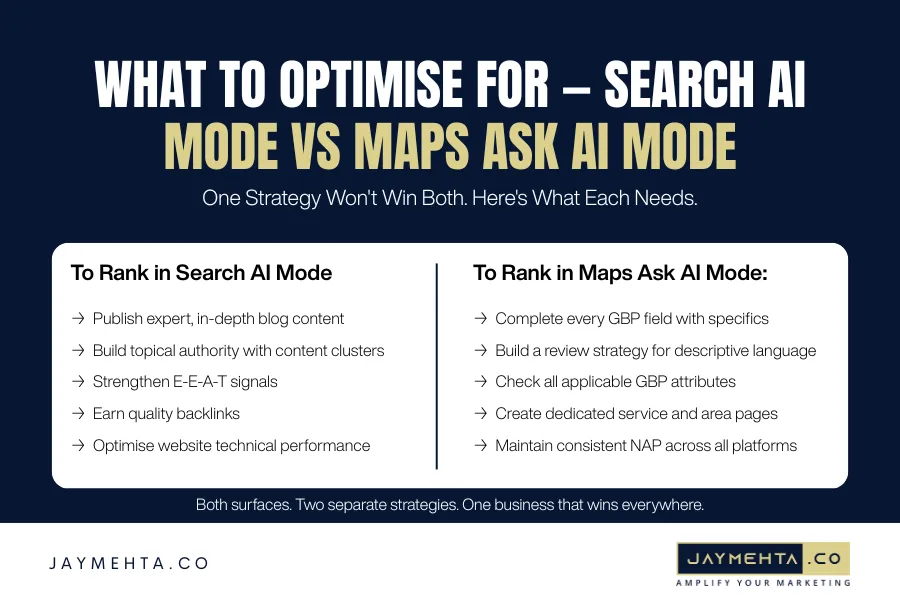
To Rank in Google Search AI Mode
Your website is your primary asset here. The AI surfaces content from publishers and businesses it considers authoritative and trustworthy on a given topic.
- Publish in-depth, expert content on topics your customers search for not just service pages, but genuinely useful guides, how-tos, and explainers that demonstrate real expertise. A digital marketing agency that publishes a thorough guide on Meta Ads strategy is far more likely to appear in Search AI responses than one with only a generic services page.
- Build topical authority by covering your subject area comprehensively across multiple interconnected articles. A cluster of five articles on local SEO signals more expertise to the AI than one standalone page.
- Strengthen your E-E-A-T signals by Experience, Expertise, Authoritativeness, and Trustworthiness. Author bios, original research, expert quotes, and credible backlinks all contribute. The AI is trained to favour content that demonstrates real human expertise over generic information.
Also Check: Google Business Profile Photo Order Is Changing. Here’s Why Your Best Images Aren’t Showing First
To Rank in Google Maps Ask AI Mode
Your Google Business Profile is your primary asset here, not your website content or your backlink profile.
- Complete every GBP field with specific, detailed information. Your business description should name exact services, specific areas, clear USPs, and real differentiators, not generic marketing language.
- Build a review strategy focused on descriptive language, not just star ratings. Guide customers to mention the specific service they used in their review. The AI reads review text to match your business with specific user queries.
- Align your website with your GBP by creating dedicated service pages and localised area pages that confirm every claim your profile makes. If your GBP lists emergency AC repair, your website needs a page dedicated to that service with details, pricing, and area coverage to give the AI the confirmation it needs.
If you want visibility across both surfaces simultaneously,explore Jay Mehta Digital’s full digital marketing services covering both content-led Search AI optimisation and GBP-led Ask Maps strategy.
Conclusion
Google Maps Ask AI Mode vs Google Search AI Mode is not a question of which one matters more. Both matter but for entirely different reasons, at entirely different stages of the customer journey.
Search AI Mode captures users in research mode. Maps Ask AI Mode captures users in buying mode. A business that wins on both surfaces owns the complete customer journey from the moment someone starts learning about a topic to the moment they decide who to call.
The mistake most businesses make is treating these as one problem with one solution. They are two distinct optimisation challenges that require two distinct strategies running in parallel.
If you are ready to build visibility across both AI surfaces in 2026, book a strategy session with Jay and get a plan built specifically for where your customers are searching right now.