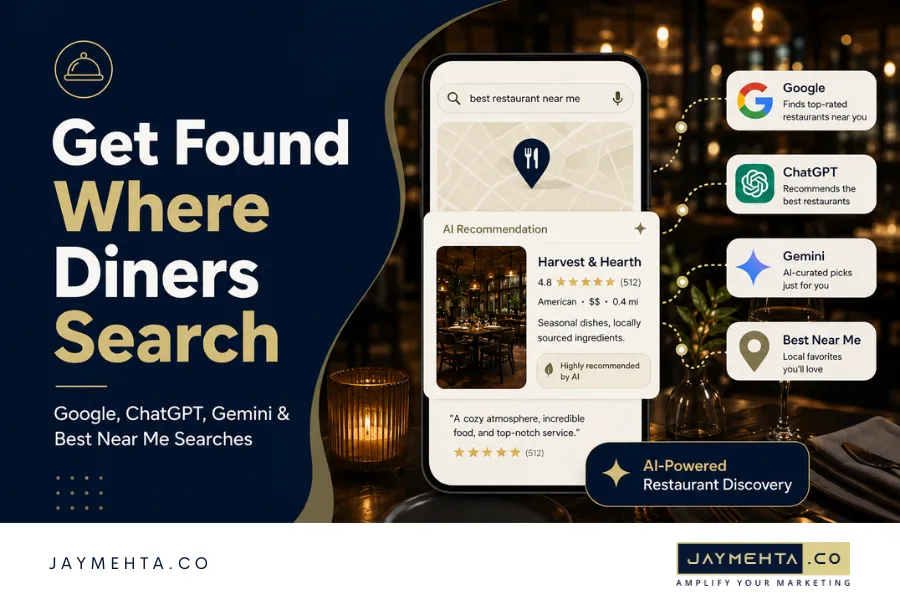
Restaurant discovery is changing fast. A few years ago, most customers found restaurants through Google Maps, Instagram posts, review platforms, or simple searches like “pizza near me” or “best Indian restaurant nearby.” In 2026, that journey has become more advanced. Diners are now using Google AI Overviews, ChatGPT, Gemini, voice search, map searches, review summaries, and AI-powered recommendations to decide where to eat.
This means restaurant marketing is no longer only about ranking on Google. It is about making your restaurant easy for both people and AI systems to understand, trust, and recommend.
Restaurant AI search marketing is the process of optimizing your restaurant’s online presence so it can appear in traditional search results, local map results, AI-generated answers, and “best near me” recommendations.
In this guide, we will explain how restaurants can improve visibility across Google, ChatGPT, Gemini, Google AI Overviews, and local “best near me” searches in 2026.
For restaurants that want a complete digital growth strategy, Jay Mehta Digital also offers dedicated restaurant marketing solutions focused on SEO, branding, website visibility, social media, and customer acquisition.
What Is Restaurant AI Search Marketing?
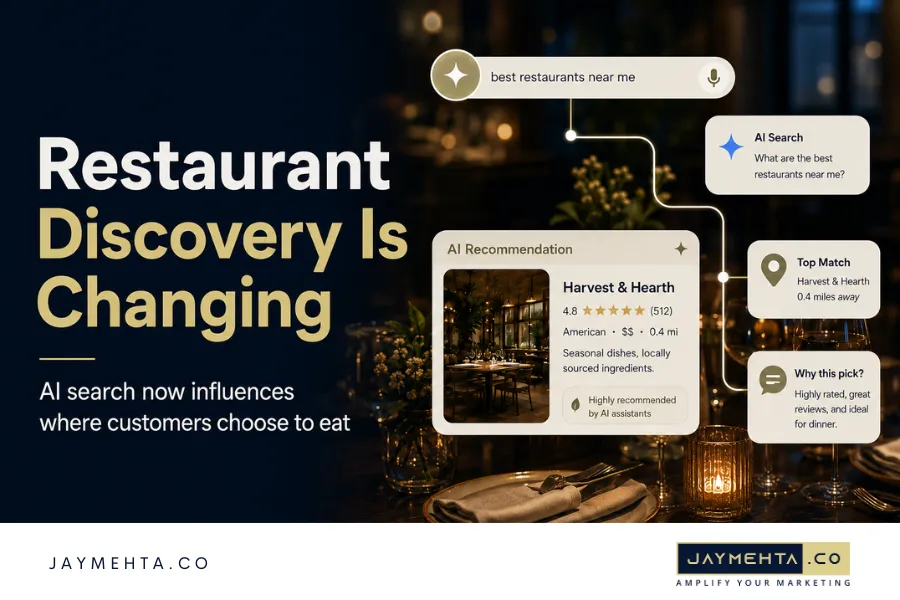
Restaurant AI search marketing means preparing your restaurant’s online information so search engines and AI tools can confidently understand and recommend your business.
Traditional SEO usually focuses on ranking web pages. Restaurant AI search marketing goes further. It focuses on your complete digital footprint, including your Google Business Profile, website, reviews, menu pages, local directories, social media presence, and third-party mentions.
AI tools do not make recommendations from one signal alone. They look for consistency, relevance, authority, freshness, and trust across multiple online sources. If your restaurant’s information is incomplete, outdated, or inconsistent, it becomes harder for AI search tools to confidently recommend you.
If your restaurant has not built a strong digital foundation yet, start with a complete digital marketing strategy that connects SEO, content, website design, social media, paid ads, and analytics.
Why AI Search Matters for Restaurants in 2026
AI search matters because customers are no longer typing only short keywords. They are asking full questions.
For example, instead of searching only “restaurant near me,” customers may now ask:
“Best family-friendly Mexican restaurant near me”
“Where should I go for vegan brunch in Austin?”
“Top restaurants with private dining near downtown Chicago”
“Best Indian restaurant for catering near me”
“Which restaurant has good reviews and outdoor seating nearby?”
These searches are more specific, more conversational, and more intent-driven. Restaurants that clearly explain their food, service, location, atmosphere, and customer experience have a better chance of being recommended.
How Restaurant Discovery Is Changing
Restaurant discovery has moved from simple map listings to multi-platform decision-making. A customer may see your restaurant on Google Maps, check your photos on Instagram, read your reviews, ask ChatGPT for suggestions, and then visit your website before making a reservation.
This is why restaurants should also understand how AI-powered map experiences are changing local discovery. Related Blog: Google Maps Ask AI Mode: What Businesses Must Know
Google, ChatGPT, Gemini, and AI Recommendations
Google, ChatGPT, Gemini, and other AI-powered tools are becoming part of the customer decision journey. These tools may summarize restaurant options, compare customer reviews, suggest dining experiences, or recommend restaurants based on location and intent.
Restaurants that want to prepare for AI-powered search should also review how Google Maps and Google Search AI experiences compare.
Key Search Behaviors Restaurants Should Watch
Restaurants should pay close attention to search behaviors such as “best near me,” “open now,” “family-friendly,” “private dining,” “outdoor seating,” “catering near me,” “vegan options,” “date night restaurant,” and “restaurants with good reviews.”
These are high-intent searches because the customer is usually close to making a decision.
Why Restaurant SEO Is Changing in 2026
Restaurant SEO in 2026 is more complex because customers are searching across Google, Maps, AI tools, voice assistants, review platforms, and social media.
Ranking on Google is still important, but it is no longer the only goal. The new goal is to become a trusted restaurant entity that AI systems can understand and recommend.
For a broader foundation, restaurants can also learn from Jay Mehta Digital’s guide on Google search algorithm changes in 2026.
From Traditional Google Search to AI-Powered Discovery
Traditional SEO focuses on keywords, pages, backlinks, and rankings. AI-powered discovery focuses on deeper context.
AI systems may look at:
- Your restaurant category
- Your menu details
- Your customer reviews
- Your business hours
- Your location
- Your service area
- Your online reputation
- Your website content
- Your third-party mentions
- Your social proof
If your restaurant’s online presence is clear and consistent, AI tools can better understand what makes your restaurant relevant.
Restaurants that want to build stronger organic visibility should consider professional SEO services that include keyword strategy, technical SEO, content optimization, and local SEO.
Why Local SEO Still Matters for Restaurants
Local SEO is still one of the strongest foundations for restaurant visibility. Customers searching for food usually have local intent. They want something nearby, open, trusted, and suitable for their needs.
That is why restaurants should continue investing in local SEO services to improve visibility in Google Maps, local packs, “near me” searches, and location-based discovery.
Read also: How to Do Restaurant Marketing: 10 Powerful Strategies to Boost Your Business
Optimize Your Google Business Profile First
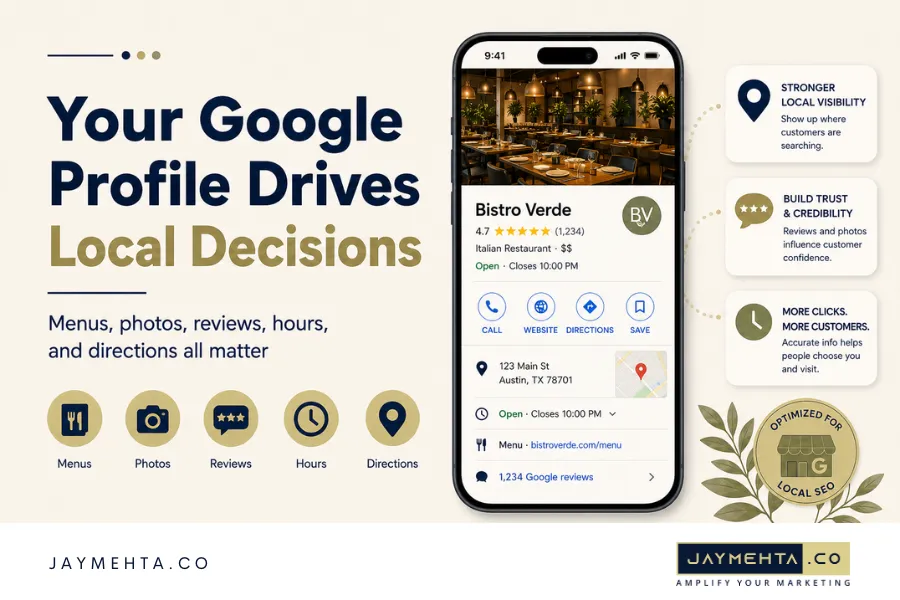
Your Google Business Profile is one of the most important assets for restaurant AI search marketing. It helps your restaurant appear in Google Search, Google Maps, and local discovery results.
Before focusing on advanced AI search strategies, restaurants should make sure their Google Business Profile is complete, accurate, and active.
Complete Your Restaurant Business Information
Start with the basics. Your restaurant name, address, phone number, website, business hours, category, and service options must be correct.
Avoid keyword stuffing in your business name. Use your real restaurant name and choose accurate business categories.
Important details to update include:
- Restaurant name
- Address
- Phone number
- Website URL
- Opening hours
- Holiday hours
- Primary category
- Secondary categories
- Dining options
- Accessibility details
- Service options
Restaurants that rely on Google Business Profile should also understand how visual updates can affect local discovery. Related Blog: Google Business Profile Photo Order Changing
Add Menu, Ordering, and Reservation Links
Customers should be able to take action quickly. Add direct links for:
- Menu
- Online ordering
- Table reservations
- Catering inquiries
- Private event bookings
- Delivery platforms
If a customer finds your restaurant but cannot easily view the menu or book a table, you may lose that customer to a competitor.
Use Photos, Videos, and Google Posts
Food is visual. High-quality images help customers understand your restaurant experience before they visit.
Upload photos of:
- Signature dishes
- Dining area
- Exterior signage
- Staff
- Events
- Drinks
- Desserts
- Catering setups
- Outdoor seating
Google Posts can also be used to promote events, seasonal menus, limited-time offers, holiday specials, and catering services.
Build an AI-Friendly Restaurant Website
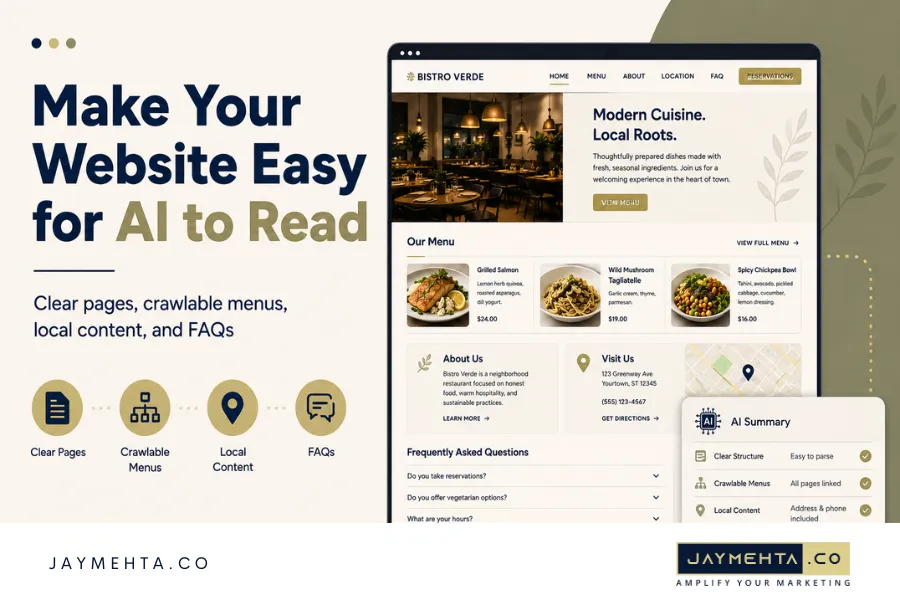
Your restaurant website should not only look attractive. It should clearly explain who you are, what you serve, where you are located, and why customers should choose you.
AI search tools need clean, specific, and structured information. If your website only has a PDF menu and a few images, it may not provide enough context for AI systems to understand your restaurant properly.
Restaurants planning a new website should review this related guide: How to Create a Restaurant Website
Create Clear Website Pages for Search Engines and AI Tools
Your website should include clear pages that answer the most important customer questions.
Homepage, Menu Location Page, and About Page
Your homepage should explain your cuisine, location, atmosphere, and unique selling point.
Your menu page should include crawlable text, not just a PDF or image. Your location page should include address, directions, parking information, nearby landmarks, and service area details.
Your about page should tell your story, chef background, food philosophy, and community connection.
If your restaurant website structure needs improvement, Jay Mehta Digital also offers website design services and website design consultation.
Catering, Private Reviews, and FAQ Pages
If your restaurant offers catering, private dining, group events, birthdays, corporate lunches, or wedding catering, create dedicated pages for each service.
These pages help your restaurant rank for specific searches like:
- Restaurant catering near me
- Private dining restaurant in [city]
- Birthday dinner restaurant near me
- Corporate lunch catering in [city]
A strong FAQ page also helps answer customer questions in a format that search engines and AI tools can easily understand.
For better content planning, restaurants can also explore Jay Mehta Digital’s content marketing services to create SEO-friendly pages, blogs, and local content.
Create Content for “Best Near Me” Searches
“Best near me” searches are highly valuable because they usually come from customers ready to take action.
Examples include:
- Best pizza near me
- Best brunch near me
- Best restaurant for date night near me
- Best vegan restaurant near me
- Best catering restaurant near me
- Best family restaurant near me
- Best restaurant with outdoor seating near me
To appear for these searches, restaurants need specific content that matches customer intent.
Target High-Intent Local Restaurant Keywords
Use keywords that combine cuisine, location, and customer need.
Examples:
- Best Indian restaurant in Austin
- Family-friendly restaurant in Dallas
- Vegan brunch in Chicago
- Pizza delivery near downtown
- Private dining restaurant in Houston
- Office lunch catering near me
These keywords should be added naturally to website pages, blogs, meta titles, headings, FAQs, and image alt text.
For a stronger keyword strategy, use a proper keyword research and analysis process before creating pages.
Build Occasion-Based Restaurant Pages
Occasion-based pages help your restaurant appear for searches tied to specific dining needs.
Date Night, Catering, and Private Dining Pages
Create dedicated content for:
- Date night dining
- Family dinner
- Birthday parties
- Corporate lunches
- Private events
- Holiday catering
- Outdoor dining
- Weekend brunch
- Late-night food
These pages help AI tools understand when your restaurant is the right recommendation.
Use Reviews as AI Search Signals
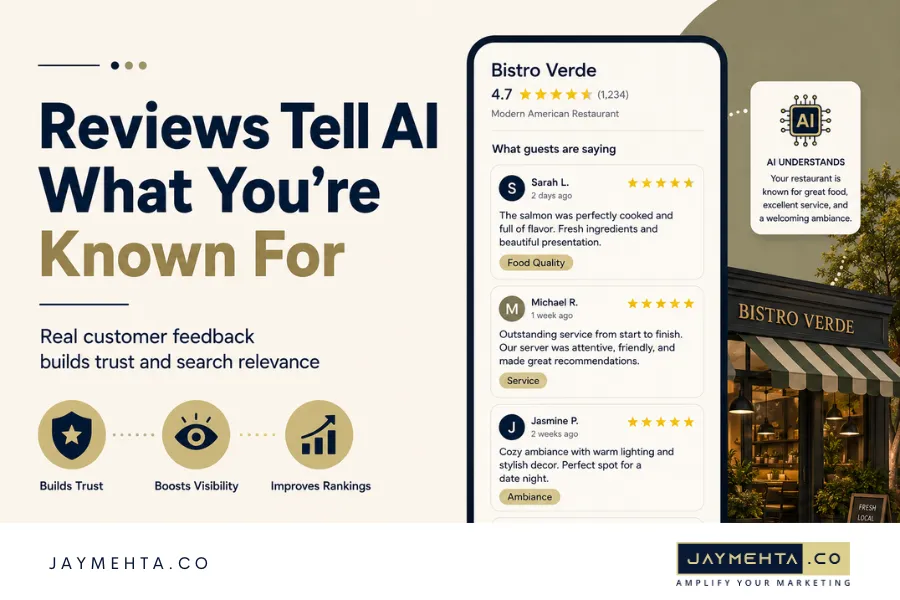
Reviews are one of the strongest trust signals for restaurant AI search marketing. They help customers make decisions, and they also help search engines understand what your restaurant is known for.
If many customers mention “best tacos,” “friendly staff,” “quick takeout,” “great vegan options,” or “perfect for date night,” these phrases help build a stronger identity around your restaurant.
Why Reviews Help AI Understand Your Restaurant
Reviews give AI tools real customer language. They show what people actually like about your restaurant.
AI search systems may use review patterns to understand:
- Popular dishes
- Service quality
- Atmosphere
- Dining occasions
- Location relevance
- Customer satisfaction
- Special menu options
Restaurants can strengthen this process by combining review insights with SEO content optimization.
How to Build a Strong Restaurant Review Strategy
A strong review strategy should include:
- Asking happy customers for reviews
- Using QR codes on receipts or table cards
- Sending follow-up review requests
- Responding to positive and negative reviews
- Tracking repeated review phrases
- Using review insights in website content
Avoid fake reviews. They can damage trust and create long-term reputation problems.
Optimize for Google AI Overviews
Google AI Overviews are changing how users receive answers. Instead of only showing a list of links, Google may generate an AI-assisted answer for certain searches.
For restaurants, restaurant Google AI Overview SEO means creating content that is helpful, structured, specific, and easy to understand.
How Google AI Overviews Affect Restaurant Visibility
AI Overviews may summarize options, answer local questions, or provide quick recommendations. If your restaurant content is clear, detailed, and crawlable, it has a better chance of being understood by Google’s AI systems.
Restaurants should also understand broader search behavior shifts through this related article: Google I/O and Marketing Live 2026 Updates
Create Helpful and Structured Restaurant Content
Restaurant content should answer real customer questions.
Examples:
- What are your most popular dishes?
- Do you offer vegetarian options?
- Do you offer catering?
- Is your restaurant good for families?
- Do you have parking?
- Do you take reservations?
- Do you offer private dining?
Use FAQs, and Schema Markup
FAQs help structure your content in a question-answer format. Local content helps connect your restaurant to your city or neighborhood. Schema markup helps search engines understand your business details.
Related Blog: AI-Powered SEO: 9 Key Principles for Next-Level Content Creation
Get Found on ChatGPT Search
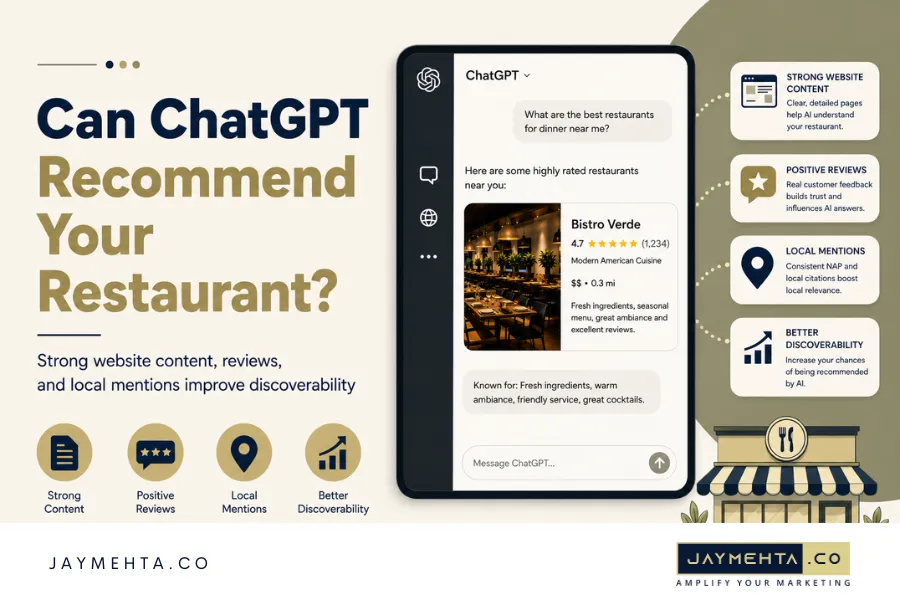
ChatGPT search is becoming part of how customers discover restaurants, compare options, and ask for recommendations.
A customer may ask:
“What are the best restaurants near me for dinner tonight?”
“Find a good Italian restaurant with outdoor seating.”
“Where can I get catering for a small office lunch?”
“Which restaurants nearby have vegan options?”
“What is a good place for a birthday dinner?”
You cannot directly force ChatGPT to recommend your restaurant. But you can improve your chances by strengthening your online presence across trusted sources.
How ChatGPT May Recommend Restaurants
ChatGPT may use available web information, business details, reviews, local mentions, and relevant content to answer restaurant-related questions.
That is why your restaurant needs strong visibility beyond only your website.
Related Blog: ChatGPT vs Google Bard vs Bing AI
Improve Your Restaurant’s Public Digital Footprint
Your public digital footprint includes every trusted place where your restaurant appears online.
Website Content, Local Mentions, and Directory Listings
Improve your visibility by focusing on:
- A strong restaurant website
- Updated menu pages
- Consistent local listings
- Positive reviews
- Food blog mentions
- Local media coverage
- Social media activity
- Directory profiles
- Community partnerships
The stronger your digital footprint, the easier it becomes for AI tools to understand and reference your restaurant.
Prepare Your Restaurant for Gemini and Google AI Experiences
Gemini is part of Google’s broader AI ecosystem. That means your visibility across Google Search, Maps, Business Profile, reviews, website content, and local SEO becomes even more important.
Why Google’s AI Ecosystem Matters for Restaurants
Google’s AI ecosystem connects search intent, local data, business information, reviews, and web content. If your restaurant is already strong across Google platforms, you are better prepared for AI-powered discovery.
Related Blog: Rank on Google Maps Ask AI Mode
Strengthen Your Restaurant Identity Across Google Platforms
To strengthen your restaurant identity, make sure your Google presence clearly communicates:
- Cuisine type
- Location
- Menu highlights
- Dining experience
- Customer reviews
- Service options
- Photos
- Reservation options
- Ordering options
Your goal is to make your restaurant easy to understand at a glance.
Make Your Menu Searchable and AI-Readable
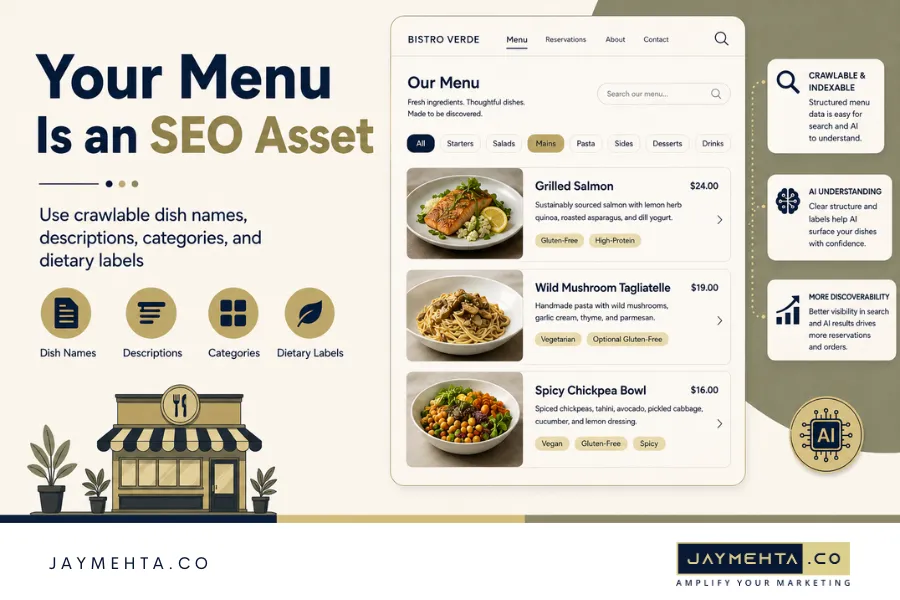
Your menu is one of your most important SEO assets. Many restaurants still upload their menu only as a PDF or image, which limits search visibility.
A searchable, AI-readable menu gives search engines more context about what your restaurant offers.
Why PDF Menus Are Not Enough
PDF menus can be difficult to read on mobile and may not provide the best SEO value. If your menu information is hidden inside a file, search engines and AI tools may not fully understand your dishes.
Create a Crawlable HTML Menu Page
Create a menu page with real text that search engines can crawl.
Add Dish Names Dietary Labels, and Popular Items
A strong menu page should include:
- Dish categories
- Dish names
- Short descriptions
- Ingredients or highlights
- Dietary labels
- Popular items
- Price ranges if appropriate
- Photos for signature dishes
- Internal links to ordering or reservations
Example:
Paneer Butter Masala Pizza
A rich Indian-fusion pizza made with creamy paneer butter masala sauce, mozzarella cheese, fresh toppings, and house spices. A popular vegetarian option for customers looking for bold flavor.
This gives search engines and AI tools more context than simply listing “Paneer Pizza.”
For better website structure, restaurants can also review: SEO Website Design Structure to Boost Rankings
Use Social Media to Support AI Search Visibility
Social media does not replace your website or Google Business Profile, but it supports restaurant discovery and brand trust.
Diners often check Instagram, TikTok, Facebook, and YouTube Shorts before deciding where to eat.
Create Search-Friendly Restaurant Social Content
Strong restaurant social content includes:
- Behind-the-scenes kitchen videos
- Chef plating videos
- Customer reaction clips
- New menu item reveals
- Catering setup videos
- Local event promotions
- Seasonal specials
- Staff stories
- Customer-generated content
Restaurants can build a stronger social presence with professional social media marketing services.
Use Location Tags, Dish Names, and Customer-Generated Content
To make your social content more search-friendly:
- Use location tags
- Mention your city or neighborhood
- Add dish names in captions
- Use cuisine-related hashtags
- Encourage customers to tag your restaurant
- Share customer photos and videos
- Repurpose social content into website blogs
Social proof supports your broader digital presence and helps create more context around your restaurant brand.
Related Blog: How Restaurants Use Instagram Reels to Get Local Customers
Build Local Citations and Third-Party Authority
AI systems often look for consistency across multiple sources. If your restaurant appears on trusted local and industry platforms with consistent information, your online presence becomes stronger.
Keep Restaurant Information Consistent Across the Web
Your restaurant name, address, phone number, website, hours, menu link, and reservation link should be consistent everywhere.
Important platforms include:
- Google Business Profile
- Apple Maps
- Bing Places
- Yelp
- TripAdvisor
- OpenTable
- DoorDash
- Uber Eats
- Grubhub
- Local chamber of commerce
- Local tourism websites
- Food blogs
- Restaurant directories
Related Blog: How to Add Your Business to Apple Maps
Get Listed on Trusted Restaurant and Local Platforms
Third-party authority helps your restaurant build trust. Local blogs, news websites, business directories, community websites, and tourism guides can all support your restaurant’s visibility.
Jay Mehta Digital’s off-page SEO services can support citation building, authority development, and stronger external visibility.
Create Local Restaurant Blog Content
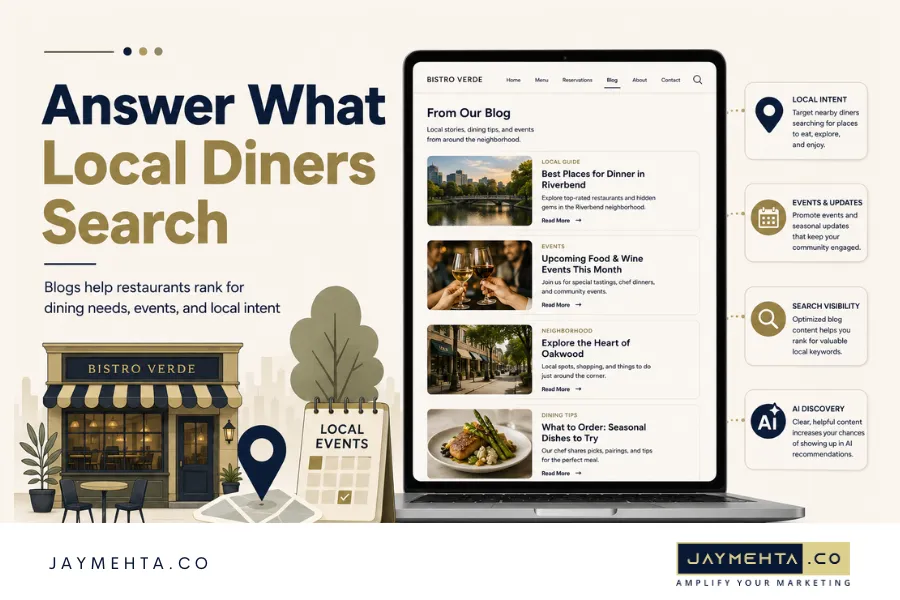
Blog content helps restaurants target specific customer questions and local search intent. Many restaurant websites do not use blogging properly, which creates an opportunity for those that do.
Blog Topics That Help Restaurants Rank in AI Search
Useful blog topics include:
- Best Family Dinner Spots in [City]
- How to Choose the Right Restaurant for a Private Event
- Best Foods to Order for Office Catering
- What Makes a Great Date Night Restaurant?
- Top Vegetarian Dishes to Try at Our Restaurant
- How to Plan a Stress-Free Restaurant Birthday Party
- Best Lunch Options for Busy Professionals in [City]
- Why Local SEO Matters for Restaurants in 2026
- How AI Search Is Changing Restaurant Discovery
Restaurants that want to build a long-term publishing plan should review: How to Create a Content Marketing Strategy
How Blog Content Supports Local SEO and AI Visibility
A good restaurant blog should include:
- Local keywords
- Helpful headings
- Internal links
- Menu mentions
- Reservation or ordering CTA
- FAQs
- Original photos
- Clear location relevance
Restaurants that publish helpful content can build more topical authority around their cuisine, location, services, and dining experience.
For hands-on support, Jay Mehta Digital offers SEO-optimized content services.
Add Schema Markup to Help Search Engines Understand Your Restaurant
Schema markup is structured data that helps search engines understand your website content. For restaurants, schema can provide important context about your business.
Important Schema Types for Restaurants
Useful schema types include:
- Restaurant schema
- LocalBusiness schema
- Menu schema
- FAQ schema
- Review schema
- AggregateRating schema
- Breadcrumb schema
- Event schema
- Organization schema
Restaurant Schema, Menu Schema, and FAQ Schema
Restaurant schema can help identify your business as a restaurant. LocalBusiness schema can support local SEO. Menu schema can help search engines understand your food offerings. FAQ schema can help structure customer questions.
Schema does not guarantee rankings, but it improves clarity for search engines and supports better content understanding.
Restaurants with technical SEO issues can benefit from technical SEO services or a detailed technical SEO audit checklist.
Improve Website Experience for Mobile Diners
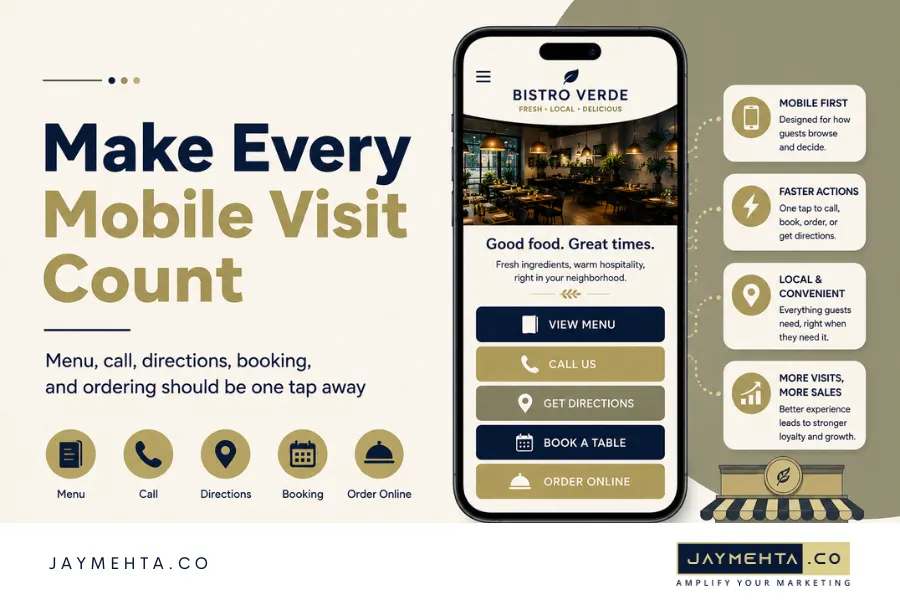
Most restaurant searches happen on mobile devices. Customers want quick answers, not complicated navigation.
If someone finds your restaurant through search or AI but lands on a slow or confusing website, you may lose the visit, call, order, or reservation.
Make It Easy to View Menu, Call, Order, Reserve, and Get Directions
Your website should make it easy to:
- View the menu
- Call the restaurant
- Get directions
- Reserve a table
- Order online
- Check hours
- Find parking information
- View photos
- Ask catering questions
- Submit an event inquiry
A strong restaurant website should connect SEO and user experience. Useful Resource: Boost Digital Presence With a Powerful Website
Mobile Optimization Checklist for Restaurants
Use this mobile checklist:
- Fast loading speed
- Clickable phone number
- Sticky reservation or order button
- Simple menu layout
- Easy-to-read text
- Compressed images
- Clear location map
- No intrusive popups
- Accessible design
- Visible CTAs
Good mobile experience turns search visibility into real customer action.
Track Your Restaurant AI Search Visibility
Restaurant AI search marketing needs measurement. Traditional SEO reports are useful, but restaurants should also track local search and AI discovery signals.
Important Metrics to Monitor
Important metrics include:
- Google Business Profile views
- Google Maps direction requests
- Phone calls from Google
- Website clicks from Google Business Profile
- Keyword rankings
- Local pack rankings
- Organic traffic
- Menu page visits
- Reservation clicks
- Online order clicks
- Review growth
- Review keywords
- Brand mentions
- Referral traffic from directories
- Social engagement
- Conversion rate from local landing pages
For deeper performance evaluation, Jay Mehta Digital provides SEO analysis services and broader digital marketing analysis.
How to Test Visibility on Google, ChatGPT, and Gemini
You can manually test visibility by asking:
- What are the best restaurants near [location]?
- Where can I get [cuisine] near [city]?
- Recommend restaurants for family dinner in [area].
- Which restaurants offer catering near [location]?
- What is the best place for [dish] near me?
Record whether your restaurant appears, how it is described, and which competitors are mentioned. This helps identify gaps in your content, reviews, and local presence.
Common Mistakes Restaurants Should Avoid
Many restaurants fail at AI search visibility because they overlook basic digital marketing foundations.
Mistakes That Hurt Restaurant AI Search Visibility
Avoid these mistakes:
- Using only a PDF menu
- Ignoring Google Business Profile updates
- Not responding to reviews
- Having inconsistent hours online
- Using thin website content
- Not creating location-specific pages
- Not adding reservation or ordering links
- Not publishing fresh content
- Ignoring schema markup
- Using low-quality food photos
- Not tracking search visibility
- Copying generic restaurant descriptions
- Depending only on Instagram
Instagram is useful, but it cannot be your entire restaurant marketing strategy. Your website, Google profile, reviews, local citations, structured content, and social proof all work together.
Related Blog: Digital Marketing Tips for Small Businesses
30-Day Restaurant AI Search Marketing Action Plan
Restaurants do not need to fix everything at once. Start with a simple 30-day action plan.
Week 1: Fix the Foundation
- Update your Google Business Profile
- Check hours, address, phone number, and menu links
- Upload fresh photos
- Review all directory listings
- Fix inconsistent business information
Week 2: Improve Website Content
- Create or update your menu page
- Add location-based content
- Add clear reservation and ordering CTAs
- Create FAQs
- Add internal links
Week 3: Strengthen Reviews
- Ask recent customers for reviews
- Respond to existing reviews
- Identify common review keywords
- Use positive review themes in website copy
Week 4: Expand AI Search Signals
- Add schema markup
- Publish one local restaurant blog
- Update social media profiles
- Test ChatGPT, Gemini, and Google searches
- Record where your restaurant appears and where competitors appear
This plan creates a strong foundation for restaurant AI search marketing without overwhelming your team.
Conclusion: Restaurant Visibility Now Depends on Search, AI, and Trust
Restaurant marketing in 2026 is no longer limited to ranking on Google or posting food photos on Instagram. Diners are using Google Search, Google Maps, AI Overviews, ChatGPT, Gemini, review platforms, and “best near me” searches to decide where to eat.
To win in this new environment, restaurants need a stronger digital foundation. That means a complete Google Business Profile, a clear and crawlable website, searchable menu pages, strong reviews, structured data, local citations, helpful content, and a consistent brand presence across the web.
Restaurant AI search marketing is not about tricking AI tools. It is about making your restaurant easier to understand, easier to trust, and easier to recommend.
How Jay Mehta Digital Can Help Restaurants Get Found in 2026
At Jay Mehta Digital, we help restaurants build visibility across local SEO, Google Business Profile, website content, paid ads, reviews, and AI-powered search experiences.
If your restaurant wants to get found on Google, ChatGPT, Gemini, and “best near me” searches in 2026, our team can help you create a strategy that turns online discovery into real reservations, orders, and foot traffic.
Start with Jay Mehta Digital’s restaurant marketing solutions or meet with Jay to discuss your restaurant growth plan.