If you want to grow your business, Meta Ads are non-negotiable. With over 3.2 billion daily active users across Facebook, Instagram, WhatsApp, and Messenger, Meta’s advertising platform gives businesses of every size access to the most powerful targeting engine ever built.
What makes Meta Ads truly transformational isn’t just the reach, it’s the precision. You can put your exact offer in front of the exact person most likely to buy, at the exact moment they’re ready. According to WordStream’s Facebook Ads Benchmark Report, the average conversion rate across industries is 9.21%, a number well-optimized campaigns regularly exceed.
Key Stat: Businesses that run structured Meta ads for maximum conversions see an average ROAS (Return on Ad Spend) of 2–4× within the first 90 days of optimization.
Understanding the Meta Platforms Advertising Ecosystem
Before spending a single rupee, understand what you’re working with. Meta ads for maximum conversions isn’t just “Facebook Ads” it’s a deeply connected network of placements, tools, and data systems.
The Four Core Placements:
- Facebook Feed & Reels: High-intent discovery, ideal for lead generation and B2B
- Instagram Feed, Stories & Reels: Visual-first platform perfect for products and lifestyle brands
- Audience Network: Extends reach to third-party apps; best for retargeting
- Messenger & WhatsApp: Click-to-message campaigns for high-ticket services and local businesses
The Three-Level Campaign Structure:
Every Meta campaign runs on a hierarchy: Campaign → Ad Set → Ad.
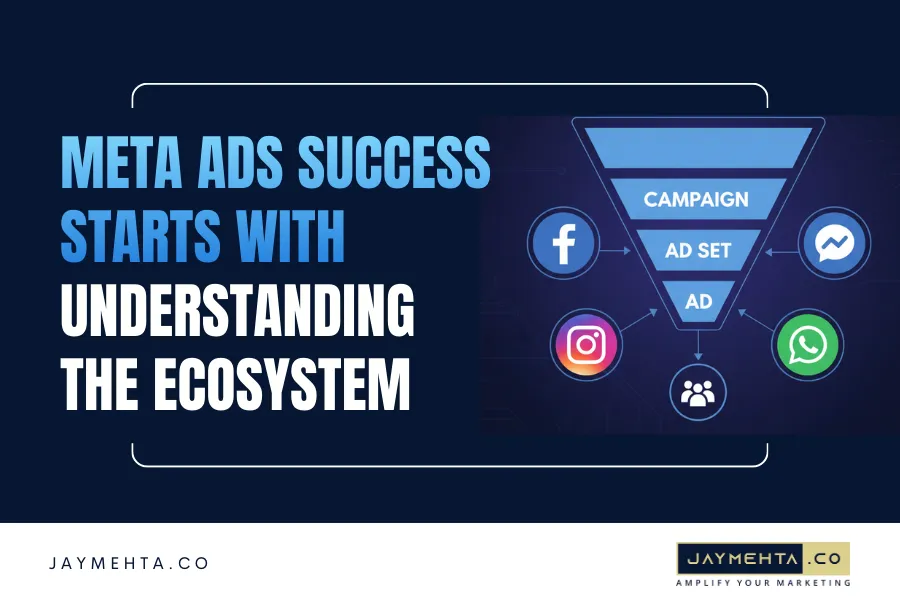
Your Campaign objective tells Meta’s algorithm what result to optimize for. Your Ad Set controls audience, budget, placement and schedule. Your Ad is the creative users actually see.
Pro Tip: Always match your campaign objective to your actual business goal. Running a Traffic objective when you want sales gives you cheap clicks but zero conversions, because Meta optimizes exactly for what you ask, not what you silently want.
For a complete reference, Meta’s official Ads Guide is essential reading.
Setting Clear Conversion Goals
The most common reason Meta campaigns fail isn’t budget, it’s the absence of a clearly defined conversion goal. You cannot optimize what you haven’t defined.
Before creating your first campaign, answer these three questions:
- What is the exact action I want users to take? (e.g., “Submit a lead form for a free consultation” not just “generate leads”)
- What is the monetary value of that action? (e.g., “A qualified lead is worth ₹2,000 because 20% convert into ₹10,000 clients”)
- What is my maximum profitable Cost Per Acquisition (CPA)? (This becomes your campaign’s north star metric)
“Without a clear conversion goal, you’re not running an ad campaign, you’re making a donation to Meta’s revenue.”
Setting Up Proper Tracking & Pixels
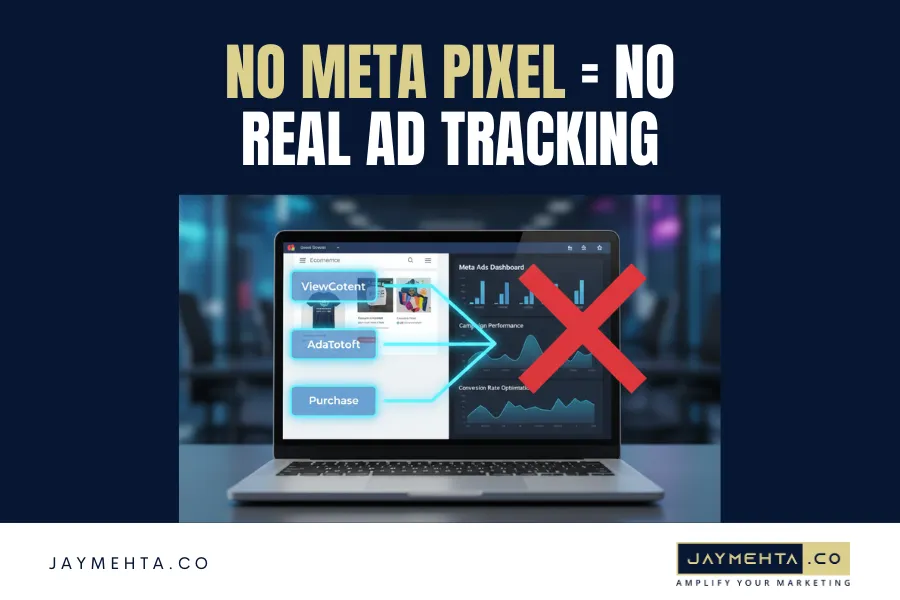
The Meta Pixel now part of the broader Meta Conversions API + Pixel system — is the absolute foundation of every high-performing campaign. Without it, you’re flying blind.
What the Meta Pixel Does:
- Tracks user behavior on your website after clicking your ad (page views, add-to-cart, checkout, purchase)
- Builds Custom Audiences from your website visitors for retargeting
- Feeds conversion data back to Meta so the algorithm finds more people like your customers (Lookalike Audiences)
- Enables accurate attribution knowing which exact campaign generated each conversion
Pixel Setup Checklist:
- Go to Events Manager in Meta Business Suite and create a new Pixel
- Install the base Pixel code on every page via GTM, manual code, or your CMS plugin
- Set up Standard Events: ViewContent, AddToCart, InitiateCheckout, Purchase, Lead
- Implement the Conversions API (CAPI) server-side to recover iOS 14+ data loss and improve attribution accuracy by 20-40%
- Use the Meta Pixel Helper Chrome Extension to verify all events fire correctly
Important: Since Apple’s iOS 14.5 ATT changes, server-side tracking via CAPI is no longer optional for serious advertisers. Learn more at Meta Conversions API Documentation.
Targeting the Right Audience
Audience targeting is where most advertisers lose money — and where experts build their edge. The key is knowing which targeting type to use at each stage of your funnel.
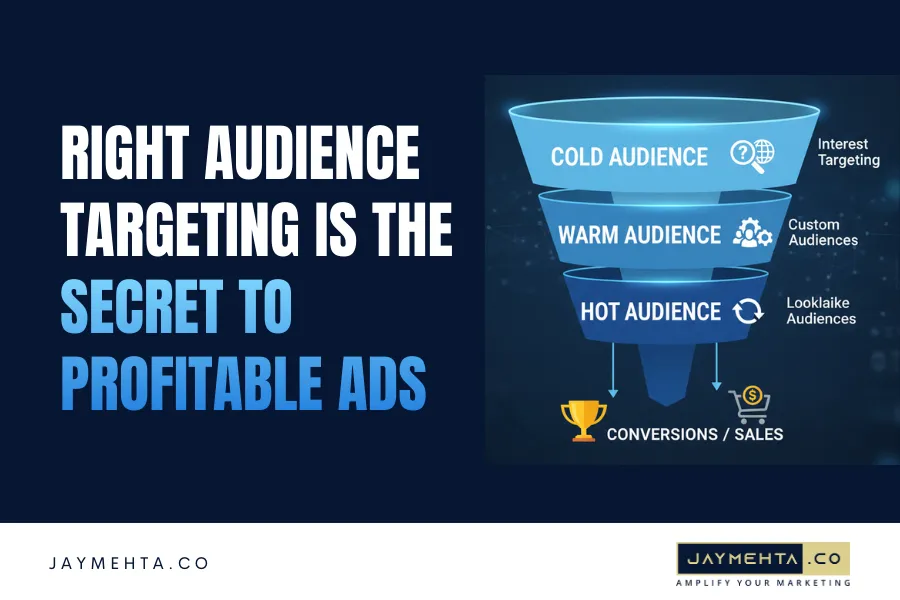
The Three-Layer Audience Architecture:
- Layer 1 Cold Audiences (Top of Funnel): People who don’t know you yet. Use Detailed Interest Targeting combined with behavioral signals (e.g., “Online Shoppers”, “Small Business Owners”). Stack 3–5 relevant interests per ad set and A/B test them.
- Layer 2 Warm Audiences (Middle of Funnel): People who’ve interacted with your brand. Build Custom Audiences from website visitors (last 30/60/180 days), video viewers (50%+), Instagram/Facebook page engagers, and email list uploads. These convert at 2–5× the rate of cold traffic.
- Layer 3 Hot Audiences (Bottom of Funnel): Your highest-intent prospects people who visited your pricing page, added to cart but didn’t purchase, or submitted a partial form. Retarget these with urgency-driven offers. Even a small retargeting budget here generates disproportionate ROI.
The Lookalike Advantage: Once your Pixel has 1,000+ conversion events, build a 1% Lookalike Audience from your best customers. Meta’s algorithm will find statistically similar users across its entire database often outperforming manual interest targeting by 30–60%. Social Media Examiner’s Lookalike Guide is a great resource to go deeper.
Creating High-Converting Ad Creatives
In era of AI, creativity is the target. Meta’s algorithm is so powerful that the right creative will find the right audience almost automatically. Your ad creative is the single highest-leverage variable in your campaign.
The Anatomy of a High-Converting Ad:
- Pattern Interrupt (0–0.5 sec): Your visual must stop the scroll. Use bold contrast, text overlays, or unexpected imagery. Users decide in 0.3 seconds whether to keep scrolling.
- Hook (Headline): Lead with the benefit or the problem. “Double Your Sales in 60 Days” beats “Meta Ads Services” every time.
- Body Copy: Use the PAS formula — Problem → Agitate → Solution. Keep it conversational, specific, and credibility-driven.
- Social Proof: “Join 2,400+ business owners who grew revenue with us” can double your CTR. Use real numbers and real results.
- CTA (Call to Action): Be explicit. “Book a Free Call”, “Shop Now”, “Claim Your Offer” — tell users exactly what to do and what they’ll get.
Best-Performing Ad Formats in 2026:
- Short-form Video / Reels (15–30 sec): Highest reach, lowest CPM. Lead with your hook in the first 3 seconds.
- UGC-Style Videos: Raw, authentic-looking content from real customers outperforms polished studio ads by 2–4× in most niches.
- Carousel Ads: Excellent for e-commerce product showcases. Each card is an independent click opportunity.
- Static Image Ads: Still powerful for direct response. Bold typography, single offer, contrasting CTA button color.
Landing Page Optimization
A world-class Meta Ad sending traffic to a weak landing page is like pouring water into a broken bucket. Your landing page is where conversions actually happen.
The 5-Point Landing Page Checklist:
- Message Match: The headline and visual on your landing page must mirror your ad copy exactly. Any disconnect creates friction and kills conversions.
- Single, Clear CTA: Remove all navigation menus, sidebar links, and competing buttons. One page, one goal, one button.
- Load Speed Under 3 Seconds: Every additional second reduces conversions by ~7%. Use Google PageSpeed Insights to diagnose issues.
- Trust Signals Above the Fold: Testimonials, logos, ratings, certifications, and guarantees must be visible without scrolling.
- Mobile-First Design: Over 95% of Meta Ad traffic is on mobile. Design for a 375px screen first, desktop second.
Benchmark: A well-optimized lead generation landing page should convert at 20–40%. For product sales, 2–5% is healthy. If you’re below these numbers, fix your landing page before increasing ad spend.
Testing, Optimizing & Scaling
The difference between advertisers who plateau and those who scale profitably is a systematic testing approach.
The A/B Testing Rule: Never test more than one variable at a time. Isolate creative, headline, copy, audience, or offer — one variable per test. Run until you have 50+ conversions per variant before declaring a winner.
The Three-Phase Scaling Approach:
- Validation Phase : Run 3–5 ad sets against different audiences with your best 2–3 creatives. Goal: find your winning combination with a CPA at or below your target.
- Optimization Phase: Kill underperforming ad sets. Consolidate budget into winners. Introduce 1–2 new creative variants per week to fight ad fatigue.
- Scaling Phase: Scale winning ad sets by 20–30% every 3–4 days (not overnight this resets Meta’s learning phase). Introduce Advantage+ Shopping Campaigns for e-commerce or Advantage+ Audience for lead gen.
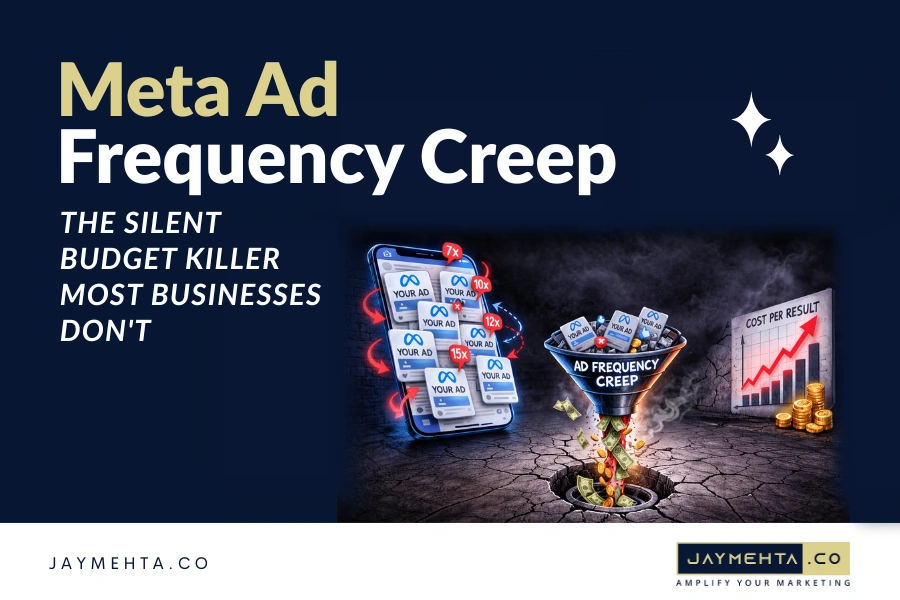
Key Metric to Watch: Your Frequency score. Once an ad set’s frequency exceeds 3–4, creative fatigue sets in. Refresh your creatives before performance drops, not after.
Conclusion
Meta Ads are not a magic button they’re a system. And like any system, they reward those who build them with care, measure them with precision, and optimize them with patience.
The businesses winning with Meta ads for maximum conversions in 2026 share five things in common:
- They have rock-solid tracking (Pixel + CAPI) so every rupee is accountable
- They build full-funnel audience architecture cold, warm, and hot layers working together
- They treat creative testing as an ongoing discipline, not a one-time task
- Their landing pages convert because traffic without conversion is just an expense
- They scale methodically increasing budgets based on data, not hope
The result is a compounding growth engine: better data → better targeting → better creatives → lower CPA → more budget → more data. This is the Meta Ads flywheel, and once it’s spinning, it’s extraordinarily powerful.
Need Help Turning Meta Ads Into a Profitable System?
Running Meta ads for maximum conversions today means managing data, creative, funnels, and strategy at the same time. Most businesses do not struggle because they lack ideas they struggle because they lack a unified system At Jay Mehta Digital we help businesses build Meta ad systems that are engineered for conversions, not just clicks. That includes:
- Proper pixel and Conversions API setup
- Full-funnel campaign architecture for leads and sales
- High-converting ad creatives and offers
- Landing page and funnel optimization
- Ongoing testing, reporting, and scaling plans
Explore our digital marketing services and see how a performance-focused Meta ads strategy can help you turn ad spend into a predictable, scalable growth engine for your business. If you are ready to get serious about Meta ads, our team is ready to help you build a system that actually converts.