“I am spending money on ads. Are they actually working?”
That is exactly what ROAS helps you understand.
In this guide, we will walk through what ROAS means, why it matters, how it is different from ROI, how to calculate and monitor it, what a “good” ROAS looks like and what to do if your ROAS is low. We will also look at how Jay Mehta Digital’s ppc advertising can help you turn ROAS from a mystery metric into a real growth lever.
To keep things easy to understand, we will use a simple example throughout: a fictional business that runs paid ads on Google and social media and wants to see clearly how much revenue those ads bring in compared to what they cost.
What Is ROAS?
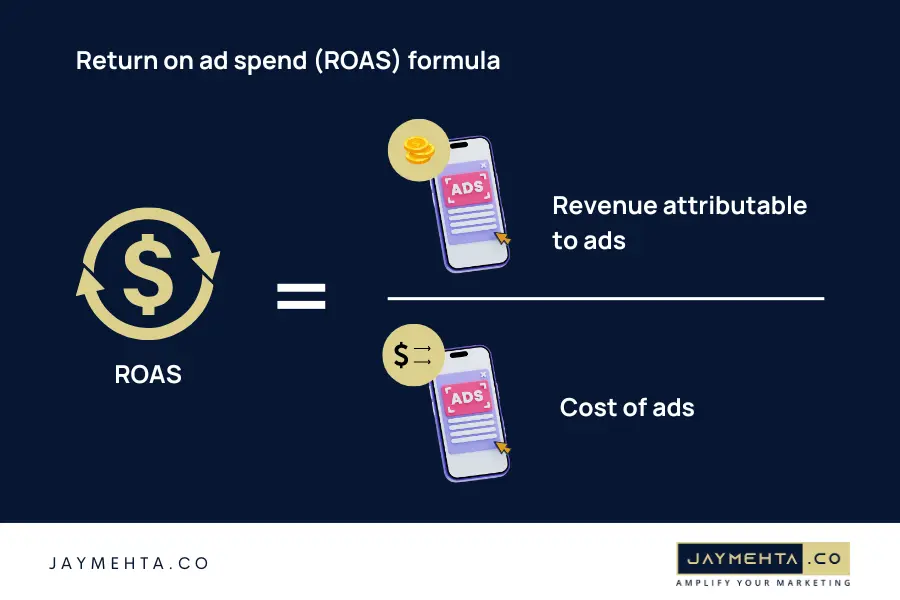
ROAS stands for Return On Ad Spend.
In simple English, ROAS tells you:
How much revenue you generate for every dollar you spend on advertising.
The basic ROAS formula is:
ROAS = Revenue from ads ÷ Cost of ads
To simplify the roas calculations, we’ll walk through an example using a fictional burger brand called Burger Rocket. If Burger Rocket spends 1,000 dollars on ads in a month and gets 4,000 dollars in revenue directly from those ads, the ROAS is:
4,000 ÷ 1,000 = 4
So we can say ROAS is 4 or 4:1.
That means for every 1 dollar you spent on ads, you brought in 4 dollars in sales.
ROAS looks only at ad spend versus revenue from those ads. It does not include rent, staff, ingredients or other costs. We will cover that when we talk about ROI.
Why Is ROAS Important?
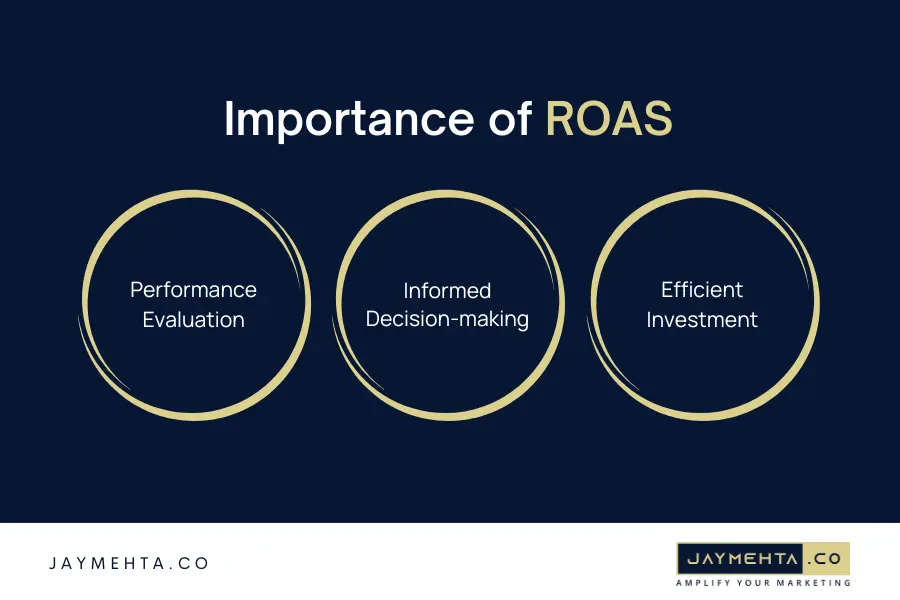
ROAS matters because it answers the most important question about your advertising:
“Are my ads paying for themselves or just burning the budget?”
For Burger Rocket, ROAS calculation helps in a few very practical ways.
First, ROAS shows which channels are actually working. If Google Search Ads are delivering a ROAS of 5 while Instagram campaigns are at 1.5, you know where to invest more and where to pause or rethink.
Second, ROAS makes budget decisions easier. If you have a stable and profitable ROAS, you can scale ad-spend more confidently. For example, going from 1,000 to 3,000 dollars per month does not feel so risky if you know you are keeping ROAS above 3 or 4.
Third, ROAS lets you compare campaigns fairly. One campaign might have cheap clicks but low spending customers. Another might have higher cost per click but bigger orders. ROAS cuts through that and compares total revenue generated versus ad spend.
Finally, ROAS helps you communicate with stakeholders. Saying “we reached 200,000 people” sounds nice, but saying “our paid marketing consultants are getting 3 dollars back for each dollar spent on ads” is clear and measurable.
ROAS vs ROI: What Is The Difference?
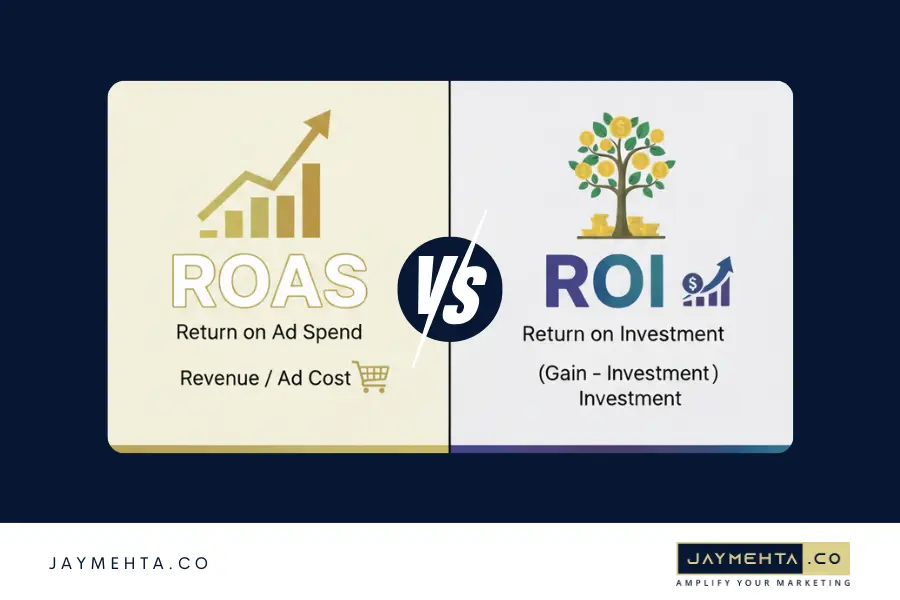
ROAS and ROI sound similar but they are not the same.
- ROAS calculation focuses only on how much revenue you generate for your ad spend.
- ROI calculation (Return On Investment) focuses on how much profit you make compared to all the costs, not just ads.
Let us go back to Burger Rocket.
In one month:
- Ad spend: 1,000 dollars.
- Revenue from customers who came from ads: 4,000 dollars.
ROAS is simple: 4,000 ÷ 1,000 = 4.
Now look at the other costs behind those sales:
- Food ingredients: 1,200 dollars
- Extra staff hours and overtime: 800 dollars
- Packaging, delivery, utilities share: 400 dollars
Total non ad costs: 2,400 dollars.
Total cost including ads: 1,000 + 2,400 = 3,400 dollars.
Profit is: 4,000 minus 3,400 = 600 dollars.
ROI looks like this:
ROI = Profit ÷ Total cost = 600 ÷ 3,400 ≈ 17.6 percent
So Burger Rocket can say:
- ROAS: “We are getting 4 dollars in sales for every 1 dollar in ad spend.”
- ROI: “After all costs, we are making about 17.6 percent profit on this activity.”
ROAS is mainly a marketing and media metric. ROI is a business and finance metric. When paired with smart conversion rate optimization strategies, the two create a complete picture of marketing impact.
ROAS Calculation Method
Once you understand the difference on what ROAS means, why it matters, how it is different from ROI, understanding of the formula for ROAS is easy. The tricky part is tracking your data correctly.
Let us walk through a basic example for Burger Rocket.
Step one is choosing the time frame. Say you want to review last month.
Step two is finding the ad spend. You add up everything you spent during that time.
- Google Ads: 600 dollars
- Meta Ads (Facebook and Instagram): 400 dollars
Total ad spend is 1,000 dollars.
Step three is the roas calculation. This should include only sales that came from your ads, not all revenue.
For example:
- Online orders with Google or Meta tracking: 3,000 dollars
- In store orders from a coupon or QR code that was used only in ads: 1,000 dollars
Total revenue from ads: 4,000 dollars.
ROAS is:
ROAS = 4,000 ÷ 1,000 = 4
To get accurate numbers, you need tracking in place. This usually means:
- Conversion tracking in Google Ads and Google Analytics
- Meta Pixel and conversions set up using the Meta Business Help Center.
- Proper UTM tags on all ad links so you can see sessions and orders coming from each campaign
An efficient campaign management and optimization is only one part, calculating ROAS once is helpful. Monitoring ROAS regularly is where you find real insights.
Burger Rocket should not only know its overall ROAS. It should know ROAS:
- By channels such as search, social, video.
- By campaigns such as “Burger near me”, “Family combo deal” or “Game night special”.
- By audience type, like new customers versus returning customers.
In most ad platforms this is quite easy to see once tracking is set up. Google Ads, for example, lets you see conversion value and cost for every campaign and ad group, so you can see ROAS directly in your reports. Shopify and similar platforms often publish data showing that many ecommerce and local businesses sit somewhere around a 2 to 3 to 1 ROAS on average, with high performing campaigns going higher when margins allow it. You can see examples of this in resources like Shopify’s guide on ROAS and advertising ROI.
Burger Rocket can create a simple dashboard (for example using Looker Studio or another reporting tool) that pulls:
- Ad spend from each platform
- Conversion value or revenue from each source
- Calculated ROAS by channel, campaign and date
What Is A Good ROAS?
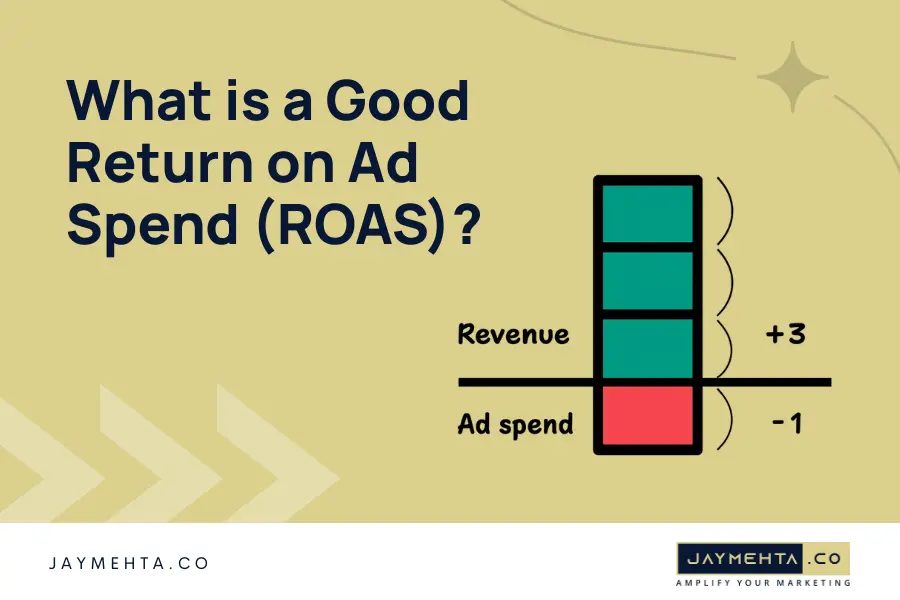
Here is the honest answer:
A “good” ROAS is one that fits your margins, your business model and your goals.
There are, however, some helpful benchmark ideas.
Across many businesses, an average ROAS often falls in the 2:3:1 range. Some marketing teams treat a ROAS of 4:1 or higher as a strong target when margins are healthy. Ecommerce advertising benchmarks typically range from 2:1 to 4:1 depending on product margins and business model. You can find these general ranges for roas calculation mentioned across marketing blogs, analytics tools and ad platform case studies, including places like Shopify and similar resources.
In the case of a fast food burger shop, margins are different from a software company or luxury brand. You might work with:
- Food cost eating a chunk of your revenue.
- Labor and rent on top of that.
- Third party delivery fees if you use apps.
That means Burger Rocket might need a higher ROAS just to break even. For example:
- If your total margins after food and operating costs give you room for about 30 percent profit on average, you might aim for a ROAS of 3 or 4 to 1 on most campaigns.
- If you are in growth mode and want to acquire as many new customers as possible, you might accept a ROAS of 2 to 1 on first orders, knowing that repeat orders will make you profitable later.
The key question for your ROAS is not “is this number good for some generic business?” but “is this ROAS sustainable and scalable for my specific business?”
That is the kind of question, a focused consulting session such as Book a ROAS review with Jay Mehta is designed to answer.
My ROAS Is Low. What Now?
Let us say Burger Rocket checks its numbers and finds a ROAS of 1.2.
That means for every 1 dollar spent, you are making 1.20 dollars in revenue from ads. This is not enough in most cases.
Before you panic and shut everything down, work through a simple review.
First, confirm that tracking is correct. If conversion tags are broken or only firing on the home page instead of the order confirmation page, ROAS numbers will be wrong. Double check with tools like Google Tag Assistant or Meta’s Pixel Helper and compare data with your POS and ordering system.
Second, look at the offer. A weak or generic offer such as “Try our burgers” will not convert as well as “Free fries with any burger today” or “Family combo for 4 under 25 dollars”. Better offers almost always help ROAS.
Third, review your targeting. If your ads are showing to people outside your delivery radius or to audiences that have no interest in burgers or fast food, you will pay for a lot of impressions and clicks that do not turn into orders.
Fourth, assess the creative. Are your photos and videos actually making people hungry? Are your headlines clear? Good creatives make people stop scrolling and pay attention, which lifts your click through rate and helps ROAS.
Finally, do a quick health check on your landing experience. If your ad takes people to a slow site, a confusing menu or a page without a clear “Order Now” button, many will simply leave. You paid for those clicks, so every lost visitor pushes ROAS down. Regular paid marketing analysis helps you spot ROAS trends before they become problems.
How To Improve Your ROAS
Improving ROAS for a burger shop or fast food brand is usually about making small, smart changes across your full funnel instead of expecting one magic trick.
Here are several practical ways Burger Rocket can increase ROAS, explained in plain language.
- The first move is to tighten targeting. Limit your ads to your real service area and to people who show stronger intent, such as those searching for “burgers near me”, “fast food Austin” or “late night burgers”. On social platforms, use lookalike audiences based on your best existing customers.
- Next, upgrade your offer. Use bundles, combos and limited time promotions. For example, if your average order value is 18 dollars and you build a family combo that nudges it up to 24 dollars, your ROAS improves even if your ad costs stay the same. The formula is simple: higher order value equals better ROAS.
- Then, refresh your creatives. Use real photos and short videos that show your best selling products. Show the burger being cooked, cheese melting, fries coming out of the fryer. Add a simple copy that says what the offer is, where you are and how to order. You can test different creatives against each other and keep the ones that drive higher ROAS.
- You should also simplify the ordering path. Make sure ad clicks go straight to an ordering page or a clear landing page, not a generic home page that forces people to hunt for the menu. The path should feel like: see the offer, click the ad, choose items, pay, done.
- Another helpful lever is average order value. Add upsell prompts such as “Add fries for a small extra cost” or “Upgrade to a combo”. Promote desserts and drinks in the cart. Many ads struggle not because they are weak, but because the average order value is too low to support a profitable ROAS calculation.
- Finally, separate your campaigns by goal. Use one style of campaign for new customers and another for retargeting people who already visited your site or engaged with your content. Retargeting often has higher ROAS because you are nudging people who already know you.
How Jay Mehta Digital Can Help You With ROAS
All of this sounds great, but if you are running a kitchen, managing staff and handling day to day operations, you probably do not want to spend your nights inside Google Ads and Meta dashboards.
That is where Jay Mehta Digital fits.
Our work with restaurants, fast casual brands, food trucks and franchises focuses heavily on improving ROAS and lifetime value, not just impressions and clicks.
A typical ROAS focused engagement might include:
- A full ROAS and tracking audit across Google, Meta and other channels.
- Fixing or setting up conversion tracking, pixels and UTM structures.
- Reviewing your menu, offers, creative and landing pages for conversion impact.
- Restructuring campaigns for clearer goals and measurement.
- Building simple dashboards so you and your team can see ROAS and key metrics without digging into every platform.
Book A ROAS Consulting Meeting With Jay Mehta
If you are currently running ads and you do not know your ROAS or you are unhappy with your ROAS, the next step is very simple:
Set up a consulting call and let us review your ROAS together.
On that call, we will:
- Look at your existing ad accounts and analytics.
- Calculate your true ROAS across different channels.
- Connect ROAS to your margins and profit.
- Build a short list of high impact changes your internal team can implement.
- Decide if you want ongoing help or just a one time strategy push.
Ready to understand and improve your ROAS? Schedule a ROAS review with Jay Mehta Digital